|
Oil on canvas, 40 x 36 1/16 inches
CR No. 1276
|
Gift of The Burnett Foundation
1997.6.24
|
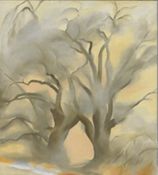
Two brown leafless cottonwood trees with intertwined branches that are enlarged to fill the entire canvas. Areas of hazy grey give a feathered softened element to the winter feeling evoked by the trees situated in a tan-orange background.
CR No. 1276
Title (1999 Catalogue Raisonné)
Winter Cottonwoods East V
Source of title: backing inscription 1, Downtown Gallery Archive, Abiquiú Notebooks. Titled "Winter Cottonwoods East V" by O'Keeffe on Abiquiú Notebooks photograph.
Alternate Title (1999 Catalogue Raisonné)
Winter Cottonwoods East, V
Source of title: Whitney Archive in 1969.
Inscriptions
Inscription: Stretcher: inaccessible Verso: inaccessible Backing:
- "Winter Cottonwoods East V 54 / 6" (graphite)
- "Box 4" (Doris Bry, black ink) (Source: Lynes, 1999)
Technique
Oil Painting
Materials
Oil on canvas
1966
Amon Carter Museum of American Art
The Museum of Fine Arts, Houston (MFA H)
1970–1971
Whitney Museum of American Art
Art Institute of Chicago
San Francisco Museum of Modern Art (SFMOMA)
1990–1991
1993–1994
Hayward Gallery
Museo del Palacio de Bellas Artes
Yokohama Museum of Art
1997–1998
1998–1999
2003–2004
2011–2012
2016–2017
2019–2020
Anita O'Keeffe (Mrs. Robert R.) Young, Newport, R.I., by 1955 Estate of Anita O'Keeffe (Mrs. Robert R.) Young, 1985 Robert R. Young Foundation, Cincinnati, Ohio, 1985 Sotheby's, New York, N.Y., sale no. 5658, lot no. 10, 3 December 1987 Gerald Peters Gallery, Santa Fe, N.Mex., 1987 Private Foundation, Fort Worth, Tex., 1996 (Source: Georgia O'Keeffe Museum)
© Georgia O'Keeffe Museum
Version History
Core fields last updated 8/26/2026
Last verified by current collection
Source System ID
93
| Date | Field | Changed From | Changed To |
|---|---|---|---|
| mm/dd/yyyy | Artist | Changed from data | Changed to data |
| mm/dd/yyyy | Main title | Changed from data | Changed to data |
| mm/dd/yyyy | Year | Changed from data | Changed to data |
| mm/dd/yyyy | Media | Changed from data | Changed to data |
| mm/dd/yyyy | Credit line | Changed from data | Changed to data |
| mm/dd/yyyy | Provenance | Changed from data | Changed to data |
Conservation
Information is from the most recently submitted report, please contact the current owner to verify updated details.Support: The support is a 2 x 2 plain-weave, processed linen canvas stretched with vertically oriented warp threads over a 2 ¾" thick, miter-cut ended, mortise-and-tenon joined, keyable softwood commercial stretcher bar, pre-cut to the whole inch. The eight wooden keys are extant and secure in the stretcher corners, which are further reinforced with cardboard triangles tacked to the verso of the stretcher.
Ground or Support Preparation: The canvas was primed by the artist and/or her assistant. It appears to have been lightly sized with a dilute protein size and then primed with lean, unsanded coats of lead white and zinc white in linseed oil in alternating coats.
Design Layers: The paints are generally applied as single-layer, thinly applied vehicular liquid consistencies with a canvas support surface texture that is prominently visible. In UV-excited auto-fluorescence, zinc white appears to dominate the lighter shades. The artist has used linear brushwork at the margins of forms, frequently leaving unpainted primed canvas visible between forms and further emphasizing edges with a ridge of slightly raised paint. Graphite or charcoal underdrawing is frequently visible at the unpainted margins between the forms. There is isolated wet-in-wet blending, but generally wet-into-dry paint application predominates with gradual, stepped transitions in value or hue.
Surface Coating: There is a relatively glossy, thick, clear synthetic varnish similar to iso-n-butyl methacrylate copolymer, which may be the same as that applied in 1960.
Framing, Backing and Hanging Hardware: Frame is a 2010 micro-climate reproduction Georgia O'Keeffe/George Of-designed cream-painted, "L" profile metal frame of extruded aluminum, micro-chamber, gasketed, with reinforced secondary frame backing, pre-conditioned silica-gel polypropylene felt RH buffer, and activated charcoal-zeolite corrugated board VOC scavenger. Glazed with non-reflective, conductive Optium acrylic glazing.
Pb soap micro-protrusions are generalized across all colors but are more concentrated in the lighter values, apparently in early phases of development in this work. Stretcher bar cracks are beginning along the left and right inner stretcher edges, but at present can only be seen in strong raking light. Stretcher bar lip cracks are found at the corner folds, some only intermittently. There is one small, pinpoint loss in the lower viewer's left corner. There are numerous brush hairs and paint bit inclusions scattered throughout the paint layer. There were losses from frame abrasions that were likely consolidated and in-painted at the time of the last varnishing. These are visible only in UV auto-fluorescence illumination.
Support: The support is a 2 x 2 heavy-weight, loose-weave cotton canvas with double threads.
Ground: The ground is oil-base (est).
Design Layers: There is a fairly thick application of opaque paint, with a thinner paint application in some areas. The palette is warm with browns, ochres, and oranges predominating. There are numerous brush-hairs and 'pebble-like' inclusions in the paint layer. The paint is primarily thick applications of opaque paint, full and rich in body (the gloss is due to surface coatings). Thinner areas of paint appear as the paint just skimming across the top of the canvas threads.
Surface Coating: Co-polymer iso and n-butyl methacrylate applied in the mid-fifties and again in 1960. In 1996, conservator Barry noted a "yellow" fluorescence (information supplied by C. Barry). The painting still exhibits a strong yellow-green fluorescence, indicating a later application of natural resin varnish.
Framing: The word has an 'L' profile metal frame that was repainted (date unknown).
DOWNLOAD IMAGE
Terms of use
The Georgia O'Keeffe Museum is dedicated to fostering access to its collections to inspire education, research, and creative engagement. Through Access O'Keeffe, the Museum’s digital catalogue raisonné project, we provide free tools for engaging with Georgia O'Keeffe’s full body of work. As part of this initiative, we encourage the download of low-resolution images for educational and fair use purposes.
Certain works by Georgia O'Keeffe are under the copyright of the Georgia O'Keeffe Museum, while others are managed by different rights holders. For commercial uses, users must seek authorization directly from the respective copyright holder.
By downloading and using these images, users agree to the following terms and conditions of use including the Museum’s reproduction guidelines. Users will play a vital role in preserving the integrity of the artist’s work while supporting broader public access.
Permitted Uses
Fair Use:
Images may be used under fair use principles for purposes such as:
- Educational: Use in teaching materials, presentations, and coursework
- Research and scholarship: Academic research articles, theses, dissertations and noncommercial publications
- Creative projects: Reference or inspiration for personal artwork, such as sketches, paintings, or digital art, if the works are not sold or used commercially.
Conditions of Use
By downloading images of artwork from Access O'Keeffe, users agree to adhere to the Museum’s reproduction guidelines for artwork by Georgia O'Keeffe. Images must not be altered, manipulated, or modified in any way that compromises their integrity or misrepresents the original work. Specifically, artworks may not be cropped, distorted, or subjected to the following alterations:
- Cropping
- Rotation, inversion, or changes to the original proportions
- Color adjustments
- Superimposition of text, graphics, or other elements
- Animation, cartooning, or other forms of reinterpretation
- Removal or modification of blemishes, inscriptions, or other original features
- Printing artwork on 3D materials, including fabrics
Unauthorized Uses
Unauthorized uses of Georgia O'Keeffe’s works include any applications that fall outside the scope of fair use, such as those intended for commercial profit generating purposes.
Examples include, but are not limited to:
- Publications and merchandise that are sold or generate income.
- Reproductions in marketing materials, advertisements, or promotional campaigns.
- Use in exhibitions or displays that charge admission fees.
For any such uses, prior written authorization must be obtained from the appropriate copyright holder noted in Access O'Keeffe.
For any commercial use, prior written permission is required from the copyright holder. Please contact the Digital Experience and Rights Manager at [email protected]
ADD TO LIST
COPY CITATION
Georgia O'Keeffe. Winter Cottonwoods East V, 1954. Access O’Keeffe, Georgia O’Keeffe Museum, https://access-ok.okeeffemuseum.org/object/93.