|
Oil on canvas, 48 1/4 x 84 3/16 inches
CR No. 1263
|
Gift of The Burnett Foundation
1997.6.29
|
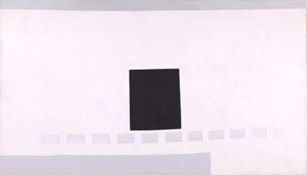
Large canvas of mostly white with an abstracted reference to the black door from the adobe wall of her Abiquiú home. The door is represented by a large black rectangle in the center, with line of grey-blue squares suggesting the stepping stones along the path. Along the top and bottom edges of the canvas are lines of a darker blue grey, thin on top, thicker along the bottom.
CR No. 1263
Title (1999 Catalogue Raisonné)
My Last Door
Source of title: Downtown Gallery Archive, Abiquiú Notebooks, Whitney Archive in 1969.
General Remarks
Downtown Gallery Archive dates 1955. Abiquiú Notebooks and Whitney Archive date 1954. dated 1952/1954 on basis of O'Keeffe letter to Edith Halpert: "I will also note that I don't intend to send you any or big pictures– and I hope you will send back to me soon the light one I have sent you. I hope it is my last door. You can call the light picture My Last Door....As I painted that light picture up here it was fine. When I got it into the studio in Abiquiú I would have given it another coat of white.– In your place I think it will be alright – but I want to paint the white whiter –Don't varnish or spray either of them. They are too fresh. Should wait a year or two" (O'Keeffe to Edith Halpert, 18 September 1952, Archive of American Art) Titled My Last Door by O'Keeffe on Abiquiú Notebooks photograph. (Source: Lynes, 1999)
Inscriptions
Inscriptions: Stretcher: "templet" (stretcher key, black ink) (Source: Lynes, 1999)
Technique
Oil Painting
Materials
Oil on canvas
1987–1989
National Gallery of Art (NGA)
Art Institute of Chicago
Dallas Museum of Art
Metropolitan Museum of Art (The Met)
Los Angeles County Museum of Art (LACMA)
1997–1998
1998–1999
1999–2000
Georgia O'Keeffe Museum
Dallas Museum of Art
The Phillips Collection
Fine Arts Museums of San Francisco
2003–2004
2008–2009
Georgia O'Keeffe Museum
Amon Carter Museum of American Art
San Jose Museum of Art
2009–2010
Whitney Museum of American Art
The Phillips Collection
Georgia O'Keeffe Museum
2010–2011
2011–2012
2016–2017
2019
2019–2020
2021–2022
Museo Nacional Thyssen-Bornemisza
Centre Georges Pompidou
Fondation Beyeler
2022–2023
Calvin Klein, New York, N.Y., 1983 (Mitchell-Innes & Nash, New York, N.Y.) The Burnett Foundation, Fort Worth, Tex., 1996 (Source: Georgia O'Keeffe Museum)
© Georgia O'Keeffe Museum
Version History
Core fields last updated 8/26/2026
Last verified by current collection
Source System ID
92
| Date | Field | Changed From | Changed To |
|---|---|---|---|
| mm/dd/yyyy | Artist | Changed from data | Changed to data |
| mm/dd/yyyy | Main title | Changed from data | Changed to data |
| mm/dd/yyyy | Year | Changed from data | Changed to data |
| mm/dd/yyyy | Media | Changed from data | Changed to data |
| mm/dd/yyyy | Credit line | Changed from data | Changed to data |
| mm/dd/yyyy | Provenance | Changed from data | Changed to data |
Conservation
Information is from the most recently submitted report, please contact the current owner to verify updated details.Support: The support is a 2 x 2 plain-weave, processed, linen canvas stretched with horizontally oriented warp threads over a 2 ¾" wide x ¾" thick, butt joined, expansion-bolt corner, 6-window stretcher with two vertical cross bars and one horizontal cross bar. The warps are stretched vertically, and the tacking edge is stapled with Monel staples.
Ground or Support Preparation: The canvas was primed by the artist and/or her assistant. It appears to have been lightly sized with a dilute protein size of rabbit-skin glue and then primed with lean, unsanded coats of lead white and zinc white in linseed oil in alternating coats.
Design Layers: The paints are applied generally as single-layer, thinly applied, matte, stiff, vehicular paste consistencies with canvas support surface texture occasionally visible. After an initial exhibition and subsequent spray varnishing in New York, the artist requested that the painting be returned to Abiquiu, where she overpainted all of the white background paints with a second application of basic lead white. In UV-excited auto-fluorescence, lead white appears to dominate the darker shades. The artist has used linear brushwork at the margins of forms, frequently leaving unpainted primed canvas visible between forms and further emphasizing edges with a ridge of slightly raised paint.
Surface Coating: The work was varnished while in New York under the direction of Edith Halpert at the Downtown Gallery. This was against the artist's instructions, as O'Keeffe had asked her agent, Doris Bry, not to have the work varnished because she was not satisfied with the white background color (see Georgia O'Keeffe Catalogue Raisonné entry 1263). After the 1955 exhibition, Halpert returned the work to the artist in Abiquiu, where she painted additional white wall paint directly over the varnished surface, leading to adhesion issues at stretcher bar edges and in other random areas.
Framing, Backing, and Hanging Hardware: Work is installed in a micro-environmentally controlled Georgia O'Keeffe/George Of-designed, "L" profile, painted aluminum microclimate frame. The frame has a gasketed secondary backing basswood strainer, gasketed Optium glazing, and Rhapid gel RH buffering sheets behind corrugated MicroChamber board dust covers to maintain a 45% relative humidity and activated charcoal-zeolite VOC scavenger. Glazed with non-reflective, conductive Optium acrylic glazing.
The work is complete, currently considered stable, and the media is secure. At some point historically, perhaps after some water-leak damage, the canvas was mounted to a new stretcher and the dimensions of the canvas expanded, with retouched edges.
The travel history of this work, however, suggests that canvas vibration excursions during transit and handling will aggravate adhesion of paint layers at or near raised cracks and areas of weakened white paint adhesion, resulting in larger cracks and new flake losses. It is also likely that vibrations during motor transport will result in some powdery abrasions at the frame rabbet, producing powdery white displays in the frame space behind the glazing.
Care should be taken not to twist or rack the painting during removal from the crate or in handling, as this will aggravate cracks and lifting paints at the stretcher bar creases. There are stretcher bar creases and associated cracks on the viewer's bottom, left, and right margins of the canvas. But there are many other raised cracks that are associated with thickened slubs in the canvas and/or thick applications of background white paint (and associated layers). All cracks have been consolidated, flattened, and often filled and inpainted using Aquazol polyoxazoline polymers with molecular weights of 50K and 200K, along with localized heat and pressure. These treatments generally occurred following the 2011–2012 European exhibition. The cracks have remained stable since that time.
Also in 2011, the work was subjected to a fine black soot at the Rome venue. The work was cleaned overall using a sodium citrate solution buffered to pH 6.0 and cleared with water and odorless hydrocarbon mineral spirits. The heaviest regions of soiling remain deeply stained in the porous paints.
DOWNLOAD IMAGE
Terms of use
The Georgia O'Keeffe Museum is dedicated to fostering access to its collections to inspire education, research, and creative engagement. Through Access O'Keeffe, the Museum’s digital catalogue raisonné project, we provide free tools for engaging with Georgia O'Keeffe’s full body of work. As part of this initiative, we encourage the download of low-resolution images for educational and fair use purposes.
Certain works by Georgia O'Keeffe are under the copyright of the Georgia O'Keeffe Museum, while others are managed by different rights holders. For commercial uses, users must seek authorization directly from the respective copyright holder.
By downloading and using these images, users agree to the following terms and conditions of use including the Museum’s reproduction guidelines. Users will play a vital role in preserving the integrity of the artist’s work while supporting broader public access.
Permitted Uses
Fair Use:
Images may be used under fair use principles for purposes such as:
- Educational: Use in teaching materials, presentations, and coursework
- Research and scholarship: Academic research articles, theses, dissertations and noncommercial publications
- Creative projects: Reference or inspiration for personal artwork, such as sketches, paintings, or digital art, if the works are not sold or used commercially.
Conditions of Use
By downloading images of artwork from Access O'Keeffe, users agree to adhere to the Museum’s reproduction guidelines for artwork by Georgia O'Keeffe. Images must not be altered, manipulated, or modified in any way that compromises their integrity or misrepresents the original work. Specifically, artworks may not be cropped, distorted, or subjected to the following alterations:
- Cropping
- Rotation, inversion, or changes to the original proportions
- Color adjustments
- Superimposition of text, graphics, or other elements
- Animation, cartooning, or other forms of reinterpretation
- Removal or modification of blemishes, inscriptions, or other original features
- Printing artwork on 3D materials, including fabrics
Unauthorized Uses
Unauthorized uses of Georgia O'Keeffe’s works include any applications that fall outside the scope of fair use, such as those intended for commercial profit generating purposes.
Examples include, but are not limited to:
- Publications and merchandise that are sold or generate income.
- Reproductions in marketing materials, advertisements, or promotional campaigns.
- Use in exhibitions or displays that charge admission fees.
For any such uses, prior written authorization must be obtained from the appropriate copyright holder noted in Access O'Keeffe.
For any commercial use, prior written permission is required from the copyright holder. Please contact the Digital Experience and Rights Manager at [email protected]
ADD TO LIST
COPY CITATION
Georgia O'Keeffe. My Last Door, 1952–1954. Access O’Keeffe, Georgia O’Keeffe Museum, https://access-ok.okeeffemuseum.org/object/92.