|
Oil on canvas, 12 x 30 1/8 inches
CR No. 995
|
Bequest of Mary P. Hines, 2022.618
|
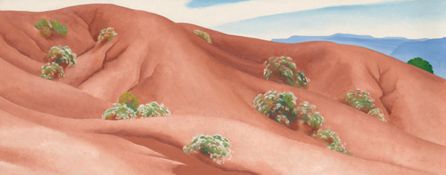
Sloping, reddish-brown hills with deep crags sweep diagonally across the canvas. Low green bushes with white flowers dot the hills. Tall mountains stand in the upper right corner of the image. A stretch of blue sky with strips of white clouds expands above the landscape.
CR No. 995
Title (1999 Catalogue Raisonné)
Red Hills with Flowers
Source of title: Whitney Archive, Downtown Gallery Archive, Abiquiú Notebooks, backing inscriptions 1, 3, 1941 New York (An American Place– O'Keeffe) exhibition checklist.
Inscriptions
Stretcher: inaccessible at time of 1999 CR. Verso: inaccessible at time of 1999 CR. Backing: 1. "Georgia O'Keeffe / Red Hills with Flowers / Summer 1940 /" (black ink) 2. {6star} (black ink) 3. "Red Hills with Flowers / by Georgia O'Keeffe Summer – 1940" (Andrew Droth, AA3, black ink) (Source: Lynes, 1999)
No markings recto. Stamped verso, bottom-left and top-right, impressed: "12 [in a shield]"; stamped verso, top-left and bottom-right, impressed: "30 [in a shield]". Markings and labels on artist backing: Inscribed verso, middle, in black marker: "Georgia O'Keeffe / Red Hills with Flowers / Summer 1940 / [six-pointed star]. label (rectangular, white) affixed verso, top-left, printed in blue ink and typed in black ink: "ARTIST GEORGIA O'KEEFFE NO. [abraded] / TITLE RED HILLS WITH FLOWERS - SUMMER [crossed out with black ink] DATE 1940 / MEDIUM OIL SIZE [30]X12 S.P. [abraded] // THE DOWNT[OWN G]ALLERY • 32 E. 51st St., New York" / stamped, bottom-left, in black ink: "[JUN 24] 1963", stamped, top-middle, in black ink: "SEP X 5 1960"; label (rectangular, white) affixed verso, left-middle, printed and typed in black ink: "Doris Bry 11 East Seventy-third Street, New York, N.Y. 10021 // RED HILLS WITH FLOWERS. 1930. / by Georgia O'Keeffe / Oil on canvas. 12 x 30""; label (rectangular, white) affixed verso, top-left, printed and typed in black ink: "FINE ARTS CONSERVATION LABORATORIES, INC. / 305 East 47th Street, New York 17, New York / PLaza 3-2090 — William J. Dobbin, Director / This painting has been treated at our laboratory / in 8/63. It has received a final / surfacing of co-polymer iso and / n-butyl methacrylate. // A permanent record of its condition together with / materials and techniques used is preserved and is / available at any time. Kindly refer to our order / number", inscribed in blue ballpoint ink: "2223"; paper (cut, rectangular, white) affixed verso, top-right, typed in black ink: "Sprayed with butyl methacrylate / polymer, March, 1948, by Keck"; paper (cut, rectangular, white) affixed verso, top-right, inscribed in black marker: "Red Hills with Flowers / by Georgia O'Keeffe Summer - 1940" / printed in black ink: "AN AMERICAN PLACE // 509 MADISON AVENUE, NEW YORK"; label (rectangular, white) affixed verso, bottom-right, printed in brown ink and typed in black ink: "GERALD P. PETERS // 439 CAMINO DEL MONTE SOL • P.O. BOX 2524 • SANTA FE, NEW MEXICO 87501 / TELEPHONE 505-988-8961 // FINE AMERICAN PAINTINGS / [line] // Artist Georgia O'Keeffe Price: / Title: RED HILLS WITH FLOWERS / Year Painted 1940 Signed: Stock Number: / C-5593-0 / Medium: Oil/Canvas Negative Number: / Size: 12x30""; label (rectangular, white) affixed verso, bottom-right, printed and typed in black ink: "The Expressionist Landscape / [line] / BMA LOAN # 88.1987 / CRATE #", inscribed in blue ballpoint ink: "5" / printed: "BIRMINGHAM MUSEUM OF ART / 2000 Eighth Avenue North / Birmingham, Alabama 35203-2278 / Cumbee Wilson / Assistant Curator / (205)254-2971", "Melissa Falkner / Registrar / (205) 254-2659", "Ruth Appelhof / Curator / (205)254-2565 / In case of emergency after hours, please phone (205) 933-1051.". Removed sticker (rectangular, white), inscribed in black ballpoint ink: "2072". (Source: Art Institute of Chicago, 2025)
Technique
Oil Painting
Materials
Oil on canvas
Georgia O’Keeffe (1887–1986), New York and New Mexico, then Abiquiu, NM, from 1949; consigned to Gerald Peters Gallery, Santa Fe, 1985 [this and the following according to email from Gerald Peters Gallery, Jan. 28, 2022; copy in curatorial object file]; sold to Jack Warner (1917-2017), Tuscaloosa, AL, 1985; consigned to Gerald Peters Gallery, Santa Fe, 1996; sold to Mary P. Hines (1931–2020; born Mary Pick), Winnetka, IL, 1997; bequeathed to the Art Institute of Chicago, 2022. (Source: Art Institute of Chicago, 2025)
© Georgia O'Keeffe Museum
Version History
Core fields last updated 8/26/2026
Last verified by current collection Dec 10 2025
Source System ID
8942
| Date | Field | Changed From | Changed To |
|---|---|---|---|
| mm/dd/yyyy | Artist | Changed from data | Changed to data |
| mm/dd/yyyy | Main title | Changed from data | Changed to data |
| mm/dd/yyyy | Year | Changed from data | Changed to data |
| mm/dd/yyyy | Media | Changed from data | Changed to data |
| mm/dd/yyyy | Credit line | Changed from data | Changed to data |
| mm/dd/yyyy | Provenance | Changed from data | Changed to data |
Conservation
Information is from the most recently submitted report, please contact the current owner to verify updated details.Information provided for Access O'Keeffe by Art Institute of Chicago in 2025.
The painting is executed on what appears to be a commercially prepared support. The canvas is primed with white which extends to the edges of the tacking margins and is attached with tacks to a four-member keyable stretcher; standard size for height and width (12 and 30 inches, respectively) are marked with stamped impressions on all four stretcher members. The canvas is trimmed flush with the verso of the stretcher and the corners neatly folded. There are several features of the technique that would normally suggest the artist began with a basic compositional sketch, however no drawing or painted sketch is readily visible in reflected infrared imaging or with stereomicroscopic examination. The transmitted infrared image offers one clue to possible compositional planning: an abandoned contour along the top of the red hills near the center that appears to be drawn. Amid the varied colored strokes of the shrubs, the ground is often visible suggesting they were executed first and the hills brought in around them. In other areas, in spaces between branches where the red hills below should be visible, O'Keeffe applied earthy red and peachy-pink paint on top of or amid them to achieve this effect. The larger forms were brought up and over one another so that the edges slightly overlap, all but obscuring any possible indications of underdrawing that may be present. Whether it was planned or executed freehand directly on the canvas, O’Keeffe made few, if any, changes throughout the work’s execution. The artist executed the work in a limited number of wet-in-wet campaigns. Much of the painting was executed using either flat-tipped, stiff-bristle brushes that leave the surface characteristically textured or a painter’s or palette knife. In some cases, the enhanced texture of stiff bristles cutting through paste-like paint is next to flat planes of knife-applied color, as in the foreground shadow. The shrubs are painted in many colors wet-into- and onto-wet with limited mixing. The brightest white details were added in a separate, perhaps final campaign. The work retains its original metal frame and artist’s cardboard backing. The frame appears to be a non-ferrous metal frame with electroplated copper on the lower half and white-metal along the top and partially down the sides to align with the horizon in the landscape. Examination of the frame from the inside reveals evidence of graphite markings on either side indicating the proposed stopping point of the white metal, and that it initially covered most of both sides. At some point after its initial plating, the silver was removed from the outwardly visible faces of the frame, but remains along the inside where the frame is in contact with the painting. Examination with UV suggests the frame is coated with lacquer to prevent corrosion and the screws holding it to the painting were chosen for their tone to match each metal.
The painting has had two known treatments, both documented on labels on the verso. In 1948, according to the label, the work was varnished with n-butyl methacrylate. In 1963, the work was treated again and varnished, but it is unclear from the information provided on the label if this later treatment included removing the earlier coating before applying another or the reason for this intervention. All eight of the stretcher keys appear to be a different wood and tone than the stretcher, suggesting they were part of a conservation campaign. Two extra sets of holes in line with those holding the frame to the canvas suggest that at some point the frame may have been modified to accept glazing with and without an added liner (now lost). The canvas appears to retain its original stretching. Tension of the support is adequate to slightly slack, with cracks forming along both the bead and inside edge of the stretcher members; there is also slight buckling of the canvas visible in raking light. There is mild cracking in some of the more thickly painted areas, specifically those where the paint was applied with a palette knife, such as the lighter portions of the sky. Small protrusions, visible in raking light and stereomicroscopic examination appear to be metal soaps. They are visible in many areas of the work, but most prevalent in the stretch of sky at right, between the heavy white clouds and the bluish silhouettes of distant plateaus. The synthetic varnish is in good condition, producing an even sheen that is not distracting, and there is no visible build-up of grime on the surface.
Published with corresponding artwork entry in Georgia O’Keeffe: Catalogue Raisonné (Lynes, 1999), this historical conservation information documents treatment decisions made during the artist’s lifetime. Lynes quotes information found on backing labels, and, when noted, from other sources.
"Sprayed with butyl methacrylate polymer, March, 1948. By Keck" (Keck typed label); "8/63 co-polymer Iso and n-butyl methacrylate 2223" (Fine Arts Conservation Laboratories typed label).
DOWNLOAD IMAGE
Terms of use
The Georgia O'Keeffe Museum is dedicated to fostering access to its collections to inspire education, research, and creative engagement. Through Access O'Keeffe, the Museum’s digital catalogue raisonné project, we provide free tools for engaging with Georgia O'Keeffe’s full body of work. As part of this initiative, we encourage the download of low-resolution images for educational and fair use purposes.
Certain works by Georgia O'Keeffe are under the copyright of the Georgia O'Keeffe Museum, while others are managed by different rights holders. For commercial uses, users must seek authorization directly from the respective copyright holder.
By downloading and using these images, users agree to the following terms and conditions of use including the Museum’s reproduction guidelines. Users will play a vital role in preserving the integrity of the artist’s work while supporting broader public access.
Permitted Uses
Fair Use:
Images may be used under fair use principles for purposes such as:
- Educational: Use in teaching materials, presentations, and coursework
- Research and scholarship: Academic research articles, theses, dissertations and noncommercial publications
- Creative projects: Reference or inspiration for personal artwork, such as sketches, paintings, or digital art, if the works are not sold or used commercially.
Conditions of Use
By downloading images of artwork from Access O'Keeffe, users agree to adhere to the Museum’s reproduction guidelines for artwork by Georgia O'Keeffe. Images must not be altered, manipulated, or modified in any way that compromises their integrity or misrepresents the original work. Specifically, artworks may not be cropped, distorted, or subjected to the following alterations:
- Cropping
- Rotation, inversion, or changes to the original proportions
- Color adjustments
- Superimposition of text, graphics, or other elements
- Animation, cartooning, or other forms of reinterpretation
- Removal or modification of blemishes, inscriptions, or other original features
- Printing artwork on 3D materials, including fabrics
Unauthorized Uses
Unauthorized uses of Georgia O'Keeffe’s works include any applications that fall outside the scope of fair use, such as those intended for commercial profit generating purposes.
Examples include, but are not limited to:
- Publications and merchandise that are sold or generate income.
- Reproductions in marketing materials, advertisements, or promotional campaigns.
- Use in exhibitions or displays that charge admission fees.
For any such uses, prior written authorization must be obtained from the appropriate copyright holder noted in Access O'Keeffe.
For any commercial use, prior written permission is required from the copyright holder. Please contact the Digital Experience and Rights Manager at [email protected]
ADD TO LIST
COPY CITATION
Georgia O'Keeffe. Red Hills with Flowers, 1940. Access O’Keeffe, Georgia O’Keeffe Museum, https://access-ok.okeeffemuseum.org/object/8942.