|
Oil on canvas, 36 1/16 x 30 inches
CR No. 601
|
Alfred Stieglitz Collection, bequest of Georgia O'Keeffe, 1987.250.1
|
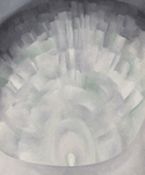
A pale yellow light bulb emanates haloes of white and gray light from the bottom center of the composition. The haloes resemble the rippled layers of tulle that form a ballerina's tutu.
CR No. 601
Title (1999 Catalogue Raisonné)
Ballet Skirt or Electric Light
Source of title: Whitney Archive.
Alternate Title (1999 Catalogue Raisonné)
White Rose – Abstraction
Source of title: Downtown Gallery Archive.
Ballet Skirt (Electric Light)
Source of title: Downtown Gallery Archive.
Ballet Skirt or Electric Light/White Rose III
Source of title: Abiquiú Notebooks.
Alternate Title
Ballet Skirt or Electric Light (from the White Rose Motif)
Source of title: Art Institute of Chicago.
Selected Exhibition Titles
Abstracion, White Rose III
Georgia O'Keeffe: The Poetry of Things, 1999, The Phillips Collection (Washington, D.C.)
General Remarks
Whitney Archive indicates, "Exam. at Amer Place, March 1946. .. . No signature. Painted 1927." Abiquiú Notebooks notes backing inscriptions 1,2 and indicates, "Signed on back of canvas." (Source: Lynes, 1999)
Inscriptions
Stretcher: "# 1" (unidentified hand, graphite). Verso: "G. O'Keeffe / Aug. – Sept. / 1927 / – " (white paint). Backing: 1. OK {5star} (graphite) [twice] 2. ". . . by Mrs. Keck, April 8 – 46" (graphite) 3. "New York – N.Y." (Art Institute of Chicago label, black ink) 4. Label: handwritten, "An American Place' / 509 Madison Avenue / New York — N.Y. / Georgia O'Keeffe" 5. Stamp: "Georgia O'Keeffe / An American Place / Room 1710— 509 Madison Ave. / New York — N.Y." (Source: Lynes, 1999)
No markings recto. Inscribed verso, top-middle, on canvas, in white paint: "G.O'Keeffe / Aug.-Sept. / 1927 [underlined]"; marked verso, bottom-middle, on stretcher, in graphite; stamped verso, top-middle, on stretcher, in black ink: "PAT. FEB'Y 2[5] 188[8] / 30". Label (rectangular, white) affixed verso, top-left, on backing, printed in black ink: "THE ART INSTITUTE OF CHICAGO / artist", typed in black ink: "Georgia O'Keeffe" / printed: "title", typed: "Abstraction-White Rose III, 1927" / printed: "medium", typed: "oil on canvas" / printed: "credit", typed: "1987.250.1" / printed: "acc. #"; label (rectangular, white) affixed verso, top-left, on backing, printed in black ink: "[illegible in image] / Georgia O'Keeffe / Ballet Skirt or Electric Light, 1927 / Oil on canvas / 36 x 30 in. / Art Institute of Chicago // Georgia O'Keeffe: Abstraction / Whitney Museum of American Art, New York, NY Sept. 17, 2009 - Jan. 17, 2010"; two labels (rectangular, white) affixed verso, left-top and top-right, on backing, typed in black ink: "Do not use eye hooks on this frame". Inscriptions and labels on artist backing: Inscribed recto, top-left, in black ink?: "Bott [...]"; marked recto, top-left, in graphite: [#]; inscribed recto, top-middle, in blue crayon: "4 [encircled] 6 p[missing]"; inscribed recto, top-middle, in graphite: "Box 11 /16"; inscribed recto, left-top, in blue crayon: "43 [underlined] / 24"; inscribed recto, top-middle, in graphite: "Aug [missing] 1927"; inscribed recto, top-middle, in graphite: "OK [in a 5-pointed star]"; inscribed recto, top-middle, in graphite: "OK [in a 6-pointed star]"; inscribed recto, top-middle, in graphite: "4 [encircled]"; inscribed recto, top-right, in graphite: "[missing] & Mrs. Keck - April 9-46"; inscribed recto, top-right, in graphite: “[illegible] [underlined]”; stamped recto, top-right, in black ink: "GEORGIA O'KEEFFE // AN AMERICAN PLACE / ROOM 1710-509 MADISON AVE. / NEW YORK. - N.Y.". Sticker (round, white) affixed recto, top-left corner, inscribed in black marker: “27”; label (square, white) affixed recto, top-left, inscribed in black ink: “”An American Place”, inscribed in graphite: “17” / inscribed in black ink: “509 Madison Avenue / New York – N.Y. // [line] // Georgia O’Keeffe”; label (rectangular, white) affixed recto, top-left, printed in black ink: “THE ART INSTITUTE OF CHICAGO / SHIPPING ROOM / CONDITION OF CONTENTS / DATE”, stamped in red ink: “MAY 18 1942” / printed: “R. O. No. / BOX No / REG. No / No. OF ITEMS / SIGNED BY”, inscribed in graphite: “[Miles]” / printed: “5000—8-26”, column break, printed: “THE ITEMS CHECKED BELOW WERE DAM- / AGED AS NOTED / SCULPTURE / CANVAS / FRAME / GLASS”, inscribed in graphite: “Finish badly / marred and miters / open upper & / Glass right corner / cracked”; label (rectangular, white) affixed recto, left-top, printed in red ink and typed in black ink: "SAN FRANCISCO MUSEUM OF ART / REG. No. 179.71 / ARTIST Georgia O'Keeffe / TITLE ABSTRACTION-WHITE ROSE III. 1927. / MEDIUM oil on canvas EX. DATES 3/19-4/25,1971 / EXHIBITION GEORGIA O'KEEFFE: RETROSPECTIVE."; label (rectangular, white), printed and typed in black ink: “WHITNEY MUSEUM OF AMERICAN ART / 945 Madison Avenue, New York, N.Y. 10021 / Artist Georgia O’Keeffe / Title ABTRACTION-WHITE ROSE III / Date 1927 Catalogue No. FL.84.59.7 / Lender Georgia O’Keeffe / Exhibition REFLECTIONS OF NATURE: / FLOWERS IN AMERICAN ART”; label (rectangular, white) affixed recto, middle-top, printed in black ink: “GEORGIA O'KEEFFE EXHIBITION // MAY 28 TO JULY 3, 1966 // THE MUSEUM OF FINE ARTS, HOUSTON”; label (square, white and grey) affixed recto, middle-top, on backing, printed in blue and white ink, and typed in black ink: "AMON CARTER MUSEUM / EXHIBIT PAINTINGS BY / GEORGIA O'KEEFFE DATE March, 1966 / TITLE WHITE ROSE III / ARTIST Georgia O'Keeffe 1927 / MEDIUM oil on canvas / "DIM. 36" x 30" / CREDIT Georgia O’Keeffe [crossed out in blue ink]”, inscribed in blue ink: “Mrs. R. R. Young / Newport, R.I.” / printed: “BOX NO. // 3501 CAMP BOWIE BOULEVARD MAIL ADDRESS BOX 2365 FORT WORTH TEXAS 76101"; stamp (rectangular, white, 3 perforated sides) affixed recto, top-middle, on backing, inscribed in red marker: "K-77"; label (rectangular, white) affixed top-right, printed and typed in black ink: “[Fasten on back of work in upper left hand corner / THE ART INSTITUTE OF CHICAGO] / EXHIBITION GEORGIA O’KEEFFE / DATES JAN. FEB. 1943 / ARTIST GEORGIA O’KEEFFE / [TITLE] BALLET SKIRT OR ELECTRIC LIGHT. 1927. (from the / WHITE ROSE MOTIF) / [OWNER] GEORGIA O’KEEFFE / [OWNER’S ADDRESS] Room 1710 / 509 Madison Avenue” / inscribed in black ink: “New York – N.Y.”; stamp (rectangular, white) affixed recto, top-right corner, typed in black ink: “[Museum of Modern Art] / LOAN / 46.72[5] / OKeeff[e]”; stamp (square, white, 4 perforated sides) affixed recto, top-right, printed and typed in black ink: “Museum of [Modern Art] / LOAN / 47.50[…] / […].31[…]”. (Source: Art Institute of Chicago, 2025)
Technique
Oil Painting
Materials
Oil on canvas
1928
1943
1946
1966
Amon Carter Museum of American Art
The Museum of Fine Arts, Houston (MFA H)
1970–1971
Whitney Museum of American Art
Art Institute of Chicago
San Francisco Museum of Modern Art (SFMOMA)
1993
Martin-Gropius-Bau
Royal Academy of Arts
1999–2000
Georgia O'Keeffe Museum
Dallas Museum of Art
The Phillips Collection
Fine Arts Museums of San Francisco
2009–2010
Whitney Museum of American Art
The Phillips Collection
Georgia O'Keeffe Museum
2024–2025
Georgia O’Keeffe (1887–1986), New York and New Mexico, then Abiquiú, NM, from 1949 [Last Will and Testament, Aug. 2, 1979; Gift Agreement, Aug. 24, 1987]; bequeathed through the Alfred Stieglitz Collection to the Art Institute of Chicago, 1987. (Source: Art Institute of Chicago, 2025)
© Art Institute of Chicago
Version History
Core fields last updated 8/26/2026
Last verified by current collection Dec 10 2025
Source System ID
8669
| Date | Field | Changed From | Changed To |
|---|---|---|---|
| mm/dd/yyyy | Artist | Changed from data | Changed to data |
| mm/dd/yyyy | Main title | Changed from data | Changed to data |
| mm/dd/yyyy | Year | Changed from data | Changed to data |
| mm/dd/yyyy | Media | Changed from data | Changed to data |
| mm/dd/yyyy | Credit line | Changed from data | Changed to data |
| mm/dd/yyyy | Provenance | Changed from data | Changed to data |
Conservation
Information is from the most recently submitted report, please contact the current owner to verify updated details.Information provided for Access O'Keeffe by Art Institute of Chicago in 2025.
The painting is executed on a single piece of pre-primed, plain weave canvas nailed to a four-member stretcher. Average thread count (standard deviation) is (14.4)V (0.6) x (14.8)H (0.3) thr/cm. The horizontal threads were determined to correspond to the warp and the vertical threads were determined to correspond to the weft (Don H. Johnson, March 2021). The stretcher itself, a Pfleger stretcher, features stretcher bars that are fully reversible—equally beveled on both sides. There is a stamp on the top stretcher member that includes the standard measurement for the width in inches (30), as well as a reference to a patent. The stamp reads “PAT. FEB’Y 2, 188…" The last digit of the year is smudged, however, patent granted to F. P. Pfleger of Joliet, IL dated February 2, 1886 for a “stretcher-frame for paintings” is a likely candidate. The white preparation extends to the edges of the bottom, left and right tacking margins; the edge of the pre-primed section is visible on the top with a margin of unprimed canvas along the top edge. The tacking margins were trimmed flush with the verso of the stretcher. Reflected and transmitted infrared imaging suggest the presence of an intermittent underdrawing, specifically along the curve at the bottom and for a select number of short, straight lines throughout the background, however they were not readily visible under stereomicroscopic examination. These images and the x-ray suggest few, if any, compositional changes were made in the painting stages of the work. The paint surface is characterized by textured brushtrokes which radiate outward from the bottom center, achieved with relatively stuff-bristle brushes and paint of a paste-like consistency. In many areas, the bristles were stiff enough to scratch through the paint layers down to the ground. The painting remains unvarnished and was signed and dated by the artist on the verso.
The painting is in stable condition. It is unlined, retaining its original stretcher and stretching, and mostly planar with a polybatting-insert-backing for added support (there is a small draw at the lower right). The patented Pfleger-type stretcher was known to utilize distinctive U-shaped keys (a single U-shaped key per corner), which are not present. Aside from a note on the original backing board—"Darks waxed by Keck April 8, 1946”— and a locally inpainted scratch, there is no documented treatment history for this work. The paint layer has limited cracking or loss, limited surface grime and remains unvarnished. It is housed in a reproduction silver-leaf "clamshell" style frame.
DOWNLOAD IMAGE
Terms of use
The Georgia O'Keeffe Museum is dedicated to fostering access to its collections to inspire education, research, and creative engagement. Through Access O'Keeffe, the Museum’s digital catalogue raisonné project, we provide free tools for engaging with Georgia O'Keeffe’s full body of work. As part of this initiative, we encourage the download of low-resolution images for educational and fair use purposes.
Certain works by Georgia O'Keeffe are under the copyright of the Georgia O'Keeffe Museum, while others are managed by different rights holders. For commercial uses, users must seek authorization directly from the respective copyright holder.
By downloading and using these images, users agree to the following terms and conditions of use including the Museum’s reproduction guidelines. Users will play a vital role in preserving the integrity of the artist’s work while supporting broader public access.
Permitted Uses
Fair Use:
Images may be used under fair use principles for purposes such as:
- Educational: Use in teaching materials, presentations, and coursework
- Research and scholarship: Academic research articles, theses, dissertations and noncommercial publications
- Creative projects: Reference or inspiration for personal artwork, such as sketches, paintings, or digital art, if the works are not sold or used commercially.
Conditions of Use
By downloading images of artwork from Access O'Keeffe, users agree to adhere to the Museum’s reproduction guidelines for artwork by Georgia O'Keeffe. Images must not be altered, manipulated, or modified in any way that compromises their integrity or misrepresents the original work. Specifically, artworks may not be cropped, distorted, or subjected to the following alterations:
- Cropping
- Rotation, inversion, or changes to the original proportions
- Color adjustments
- Superimposition of text, graphics, or other elements
- Animation, cartooning, or other forms of reinterpretation
- Removal or modification of blemishes, inscriptions, or other original features
- Printing artwork on 3D materials, including fabrics
Unauthorized Uses
Unauthorized uses of Georgia O'Keeffe’s works include any applications that fall outside the scope of fair use, such as those intended for commercial profit generating purposes.
Examples include, but are not limited to:
- Publications and merchandise that are sold or generate income.
- Reproductions in marketing materials, advertisements, or promotional campaigns.
- Use in exhibitions or displays that charge admission fees.
For any such uses, prior written authorization must be obtained from the appropriate copyright holder noted in Access O'Keeffe.
For any commercial use, prior written permission is required from the copyright holder. Please contact the Digital Experience and Rights Manager at [email protected]
ADD TO LIST
COPY CITATION
Georgia O'Keeffe. Ballet Skirt or Electric Light, 1927. Access O’Keeffe, Georgia O’Keeffe Museum, https://access-ok.okeeffemuseum.org/object/8669.