|
Oil on canvas, 23 x 19 inches
CR No. 344
|
Alfred Stieglitz Collection, gift of Georgia O'Keeffe, 1969.835
|
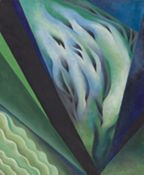
Bands of blue, black, and green extend diagonally from the bottom center of the composition. Rippling white and pale blue forms flow through the center of the canvas like petals or leaves blowing in a breeze. At the bottom left corner, layers of rippling green shapes peek into the composition.
CR No. 344
Title (1999 Catalogue Raisonné)
Blue and Green Music
Source of title: Whitney Archive, Downtown Gallery Archive, Abiquiú Notebooks.
General Remarks
Whitney Archive indicates, "See gallery photograph 4—a. Information from Miss Bry (An American Place, July 1949): On permanent loan to the AIC from Georgia O'Keeffe as part of the Alfred Stieglitz Collection." Stretcher inscription 3 dates 1921 and indicates no. 27 in 1923 New York (Anderson). Whitney Archive, Downtown Gallery Archive, Abiquiú Notebooks date 1919. Dated 1921 on basis of stretcher inscription. Pictured in 1923 New York (Anderson) Stieglitz installation photograph, see Appendix III, figure 15. Reproduced and titled Music in Vogue (October 1923); titled Music—Blue and Black and Green in Pageant of America (1927); titled Music — Blue, Black and Green in Knight Publishers, plate 6 (1937); Music Black Blue and Green in A Primer of Modern Art (1939); Music, Blue Green & Black by Stieglitz on photograph in private collection. (Source: Lynes, 1999)
Inscriptions
Stretcher: 1. "No 5 {crossed out} / Marin frame" (graphite) 2. "O'Keeffe" (Alfred Stieglitz, graphite) 3. "27 / 1921" (Alfred Stieglitz, graphite) 4. "Stieglitz / [drawing of frame] / silver leaf / 18 7/8 x 22 7/8 / O'Keeffe" (George Of, graphite). Backing: 1. "New York – NY" (Art Institute of Chicago label, black ink) 2. Stamp: "Georgia O'Keeffe / An American Place / Room 1710— 509 Madison Ave. / New York — N.Y." (Source: Lynes, 1999)
No markings recto.
Inscribed by Alfred Stieglitz verso, top-right, on stretcher, in graphite: "OKeeffe ↑"; inscribed verso, top-middle, on stretcher, in graphite: "No 5" [crossed out] / "Marin Frame"; marked verso, top-middle, on stretcher, in graphite: "X"; inscribed by O'Keeffe verso, bottom-right, on stretcher, in graphite: "Stieglitz / [drawing of frame profile] / Silver Leaf / W 18 7/8 x 22 7/8 / O'Keeffe"; inscribed by Alfred Stieglitz verso, left-bottom, on stretcher, in graphite: "27/1921".
Masking tape affixed verso, top-left, on frame, inscribed in graphite: "388.49 Geo OKeeffe / Blue & Green Music". Label (rectangular, white) affixed verso, top-left, on backing, printed and typed in black ink: "THE ART INSTITUTE OF CHICAGO / artist Georgia O'Keeffe / title Blue and Green Music / medium oil on canvas / credit / acc. $ 1969.835 / LZ-341-001 1M 1/90 (REV. 1/90)"; label (rectangular, yellow) label affixed verso, top-left, on backing, printed and typed in black ink: "Hayward Gallery London SE1 8XZ 071-928 3144 / exhibition Georgia O'Keeffe American & Modern 19 1993 / cat. no 21 / artist Georgia O'Keeffe / title Blue and Green Music 1919 / owner The Art Institute of Chicago"; label (rectangular, white) affixed verso, top-left, on backing, printed and typed in black ink: "Dex ID. 274 / National Gallery of Art / Washington, DC / Exhibit: Modern Art and America: Alfred * / Date: 01/28/01 - 04/22/01 / Artist: Georgia O'Keeffe / Title: Blue and Green Music / Lender: The Art Institute of Chicago // Cat No. 102"; label (rectangular, white) affixed verso, top-middle, on backing, printed in black and green ink: "WMAA # E.2007.0107 / Cat. Rais. # 344 / Exhibition Crate: GOKA # 344 / Georgia O'Keeffe / Blue and Green Music, 1921 / Oil on canvas / 23 x 19 in. / Art Institute of Chicago, IL // Georgia O'Keeffe: Abstraction / Whitney Museum of American Art, New York, NY Sept. 17, 2009 - Jan. 17, 2010"; label (rectangular, white) affixed verso, top-middle, on backing, printed in black ink: "Georgia O'Keeffe / Tate Modern (London, UK) / Bank Austria Kunstforum (Vienna, Austria) / Art Gallery of Ontario (Toronto, Canada) / O'Keeffe, Georgia 1887-1986 / Blue and Green Music (1919/21) / Oil paint on canvas 584 x 483 mm / The Art Institute of Chicago; Alfred Stieglitz Collection, gift / of Georgia O'Keeffe, 1969.835 / X57427", printed in red ink: "TATE"; sticker (rectangular, white) affixed verso, on backing, middle, typed in black ink: "RIGID PANEL INSERT"; sticker (cut, square, white) affixed verso, bottom-right, on backing, inscribed in black ballpoint ink: "Caisse / chenue / 130".
Removed labels from previous backing board: Stamped in black ink: "GEORGIA O'KEEFFE / AN AMERICAN PLACE / ROOM 1710-500 MADISON AVE. / NEW YORK. - N.Y.". Label (square, white), inscribed in graphite: "59", printed and typed in black ink: "Fasten on back of work in upper left hand corner / THE ART INSTITUTE OF CHICAGO / EXHIBITION GEORGIA O'KEEFFE / DATES Jan. Feb. 1943 / ARTIST GEORGIA O'KEEFFE / TITLE BLUE AND GREEN MUSIC, 1919 / OWNER GEORGIA O'KEEFFE / OWNER'S ADDRESS Room 1710 / 509 Madison Avenue" / inscribed in black marker: "New York - N.Y.". Label (rectangular, white), printed in red ink and typed in black ink: "SAN FRANCISCO MUSEUM OF ART / REG. No. 150.71 / ARTIST Georgia O'Keeffe / TITLE BLUE AND GREEN MUSIC. 1919. / MEDIUM oil on canvas EX. DATES 3/19-4/25,1971 / EXHIBITION GEORGIA O'KEEFFE: RETROSPECTIVE.". (Source: Art Institute of Chicago, 2025)
Technique
Oil Painting
Materials
Oil on canvas
1943
1970–1971
Whitney Museum of American Art
Art Institute of Chicago
San Francisco Museum of Modern Art (SFMOMA)
1993–1994
Hayward Gallery
Museo del Palacio de Bellas Artes
Yokohama Museum of Art
1998
2009–2010
Whitney Museum of American Art
The Phillips Collection
Georgia O'Keeffe Museum
2016–2017
2021–2022
Museo Nacional Thyssen-Bornemisza
Centre Georges Pompidou
Fondation Beyeler
Georgia O’Keeffe (1887–1986), New York and New Mexico, then Abiquiú, NM, from 1949 [on loan to the Art Institute of Chicago from 1949; letter from O’Keeffe to Charles C. Cunningham, Dec. 9, 1969; copy in curatorial object file]; given through the Alfred Stieglitz Collection to the Art Institute of Chicago, 1969. (Source: Art Institute of Chicago, 2025)
© Art Institute of Chicago
Version History
Core fields last updated 8/26/2026
Last verified by current collection Dec 10 2025
Source System ID
8445
| Date | Field | Changed From | Changed To |
|---|---|---|---|
| mm/dd/yyyy | Artist | Changed from data | Changed to data |
| mm/dd/yyyy | Main title | Changed from data | Changed to data |
| mm/dd/yyyy | Year | Changed from data | Changed to data |
| mm/dd/yyyy | Media | Changed from data | Changed to data |
| mm/dd/yyyy | Credit line | Changed from data | Changed to data |
| mm/dd/yyyy | Provenance | Changed from data | Changed to data |
Conservation
Information is from the most recently submitted report, please contact the current owner to verify updated details.Information provided for Access O'Keeffe by Art Institute of Chicago in 2025.
The painting is executed on a 2 × 2 basket weave canvas tacked to a four-member keyable stretcher. The average thread count (standard deviation): 20.6 (10.3 pairs) V (0.2) x 22.6 (11.3 pairs)H (0.4) thr/cm. The vertical threads were determined to correspond to the warp and the horizontal threads were determined to correspond to the weft (Don H. Johnson, March 2021). The painting has an extremely thin ground (or possibly bulked sizing layer) covering the compositional area and tacking margins that barely fills the interstices of the weave, leaving the thread tops exposed. The pronounced scalloping seen around the edges of the work and in the x-ray would normally suggest the priming was applied after the work was stretched, however the presence of the ground on the edges but not on the tacks suggests that the first preparatory layer was so thin it did not provide much stiffness to the canvas, allowing the weave to be distorted in subsequent stretching. There is also a thin, white additional layer on the compositional area only; UV fluorescence suggests the primary component of this layer is zinc white. It is unclear if either or both layers were applied by the artist. O’Keeffe began with a basic pencil sketch, making slight alterations to the major geometric forms within the drawing stage; the infrared composite shows lines roughly parallel to the current composition along some of the main diagonals as the artist manipulated these forms. Close examination of the infrared images suggests O’Keeffe faintly sketched the long diagonals by hand before coming back in with a softer pencil and the aid of a straight edge. During this reinforcing step, many of the lines were adjusted or shifted slightly. She also initially continued the strong diagonals at the lower left, where the geometric shapes give way to a series of roughly parallel waves; through the uppermost wave, a faint hint of a straight line can be seen. The soft blue and green curve at the bottom right, where the diagonals meet, was also altered, but in the painting stage, making the shape ultimately slightly more rounded on top and diminished at the bottom. The paint itself was applied in wet-in-wet layers; the dark wavy forms at the right were painted first, the lights brought in around and many of the light greens added subsequently. In the IR composite, these black forms are slightly larger than what is currently visible, indicating they were constructed first, their edges slowly painted over as the artist progressed. “Wet-in-wet,” a term generally describing the artist’s method of mixing paint on the canvas and blending through multiple colors applied at the same time rather than through layering, does not entirely accurately describe O’Keeffe’s technique, as the paints are largely rather lean in consistency, yielding a characteristically velvety surface that often retains the mark of the brush. There is no varnish on the work; the slight gloss differential noted on the relatively matte surface is a result of varying amounts of medium in the paint. The black diagonal form at the left, for example, appears slightly glossier in natural light; more medium rich, this shape slightly bleeds through the thin priming layers and can be seen in a verso photograph.
The painting was treated for minor flaking around the perimeter, thought to be the result of abrasion from the snug frame, in 1986. The work was also noted to have clouded the glass due to the tight fit of the frame and glazing creating a micro-climate. A panel-insert backing was later added to reduce vibration of the canvas. The painting is in stable condition, retaining its original stretcher and stretching, and is planar. It remains unlined and unvarnished. Some efflorescence is visible in the blacks, especially the long diagonal form left of center. Minor, local losses and abrasion are visible around the perimeter. A number of small dark spots and unidentified accretions can be found in the lower right quadrant. There is minimal grime overall. The work is housed in its original silver leaf frame. A graphite inscription on stretcher detailing frame information including a profile drawing appears to by George F. Of.
DOWNLOAD IMAGE
Terms of use
The Georgia O'Keeffe Museum is dedicated to fostering access to its collections to inspire education, research, and creative engagement. Through Access O'Keeffe, the Museum’s digital catalogue raisonné project, we provide free tools for engaging with Georgia O'Keeffe’s full body of work. As part of this initiative, we encourage the download of low-resolution images for educational and fair use purposes.
Certain works by Georgia O'Keeffe are under the copyright of the Georgia O'Keeffe Museum, while others are managed by different rights holders. For commercial uses, users must seek authorization directly from the respective copyright holder.
By downloading and using these images, users agree to the following terms and conditions of use including the Museum’s reproduction guidelines. Users will play a vital role in preserving the integrity of the artist’s work while supporting broader public access.
Permitted Uses
Fair Use:
Images may be used under fair use principles for purposes such as:
- Educational: Use in teaching materials, presentations, and coursework
- Research and scholarship: Academic research articles, theses, dissertations and noncommercial publications
- Creative projects: Reference or inspiration for personal artwork, such as sketches, paintings, or digital art, if the works are not sold or used commercially.
Conditions of Use
By downloading images of artwork from Access O'Keeffe, users agree to adhere to the Museum’s reproduction guidelines for artwork by Georgia O'Keeffe. Images must not be altered, manipulated, or modified in any way that compromises their integrity or misrepresents the original work. Specifically, artworks may not be cropped, distorted, or subjected to the following alterations:
- Cropping
- Rotation, inversion, or changes to the original proportions
- Color adjustments
- Superimposition of text, graphics, or other elements
- Animation, cartooning, or other forms of reinterpretation
- Removal or modification of blemishes, inscriptions, or other original features
- Printing artwork on 3D materials, including fabrics
Unauthorized Uses
Unauthorized uses of Georgia O'Keeffe’s works include any applications that fall outside the scope of fair use, such as those intended for commercial profit generating purposes.
Examples include, but are not limited to:
- Publications and merchandise that are sold or generate income.
- Reproductions in marketing materials, advertisements, or promotional campaigns.
- Use in exhibitions or displays that charge admission fees.
For any such uses, prior written authorization must be obtained from the appropriate copyright holder noted in Access O'Keeffe.
For any commercial use, prior written permission is required from the copyright holder. Please contact the Digital Experience and Rights Manager at [email protected]
ADD TO LIST
COPY CITATION
Georgia O'Keeffe. Blue and Green Music, 1919–1921. Access O’Keeffe, Georgia O’Keeffe Museum, https://access-ok.okeeffemuseum.org/object/8445.