
|
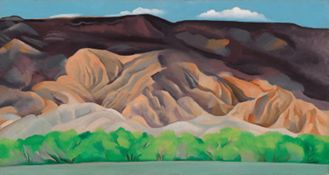
Oil on canvas, 16 x 30 inches ^ ^ ^Framed Dimensions: 17 5/16 x 31 5/16 x 1 15/16 (6/6/16)
CR No. 793
|
Gift of The Burnett Foundation
1997.6.38
|
Panoramic horizontal landscape with purple-black hills in the background, blending to sand beige hills in the middle, ending in creamy white just above the line of green trees along the bottom.
CR No. 793
Title (1999 Catalogue Raisonné)
Back of Marie's No. 4
Source of title: backing inscription 1, Whitney Archive, Abiquiú Notebooks.
Alternate Title (1999 Catalogue Raisonné)
Back of Marie's – New Mexico #4
Source of title: Downtown Gallery Archive.
Back of Marie's No. IV
Source of title: Downtown Gallery Archive.
Back of Marie's No. 4, New Mexico
Source of title: Downtown Gallery label.
General Remarks
Whitney Archive indicates "Exam. at Amer. Place, April, 1946 [notes backing inscriptions 1, 2]. Probably in 1932 O'Keeffe exh. of which we have no catalogue. Abiquiú Notebooks notes inscriptions 1–3. (Source: Lynes, 1999)
Inscriptions
Inscriptions: Stretcher: inaccessible Verso: inaccessible Backing:
- "Back of Maries No 4 / 1931" (graphite)
- OK O (graphite)
- "Back of Marie's - New Mexico #4 - 1930 / by Georgia O'Keeffe" (Alfred Stieglitz, Label: handwritten, "An American Place' / 509 Madison Ave —Room 1710 / (S.E. corner 53rd St) — New York", black ink) (Source: Lynes, 1999)
Technique
Oil Painting
Materials
Oil on canvas
2003–2004
2004–2005
Buffalo AKG Art Museum
Georgia O'Keeffe Museum
Columbus Museum of Art
2010–2011
2012–2014
Montclair Art Museum
Denver Art Museum
Georgia O'Keeffe Museum
Heard Museum
2016–2017
Heide Museum of Modern Art
Art Gallery of New South Wales
Queensland Art Gallery / Gallery of Modern Art
2017–2019
2018–2019
2024–2025
San Diego Museum of Art
Albuquerque Museum
Musee Des Beaux-Arts Montreal
Museum of Fine Arts (MFA Boston)
(Doris Bry, New York, N.Y.)
Private collection, Woodmere, N.Y., 1976
(Doris Bry, New York, N.Y.)
(Grete Meilman Fine Art, Ltd., New York, N.Y.)
Private collection, Houston, Tex., 1990
(Owings-Dewey Fine Art, Santa Fe, N.Mex.)
The Burnett Foundation, Fort Worth, Tex., 1995
Gift to the Georgia O'Keeffe Museum, 1997
(Source: Georgia O'Keeffe Museum, 2026)
© Georgia O'Keeffe Museum
Version History
Core fields last updated 8/26/2026
Last verified by current collection
Source System ID
78
| Date | Field | Changed From | Changed To |
|---|---|---|---|
| mm/dd/yyyy | Artist | Changed from data | Changed to data |
| mm/dd/yyyy | Main title | Changed from data | Changed to data |
| mm/dd/yyyy | Year | Changed from data | Changed to data |
| mm/dd/yyyy | Media | Changed from data | Changed to data |
| mm/dd/yyyy | Credit line | Changed from data | Changed to data |
| mm/dd/yyyy | Provenance | Changed from data | Changed to data |
Conservation
Information is from the most recently submitted report, please contact the current owner to verify updated details.Support: The support is a 1 x 1 twill-weave, processed, linen canvas stretched over an "American Type", double-bevel-faced, miter-cut ended, mortise-and-tenon joined, keyable softwood, commercial stretcher bar, pre-cut to the whole inch, 1 ¾" wide x ¾" thick in 16" and 30" sized lengths. The canvas is stretched with the warps in the horizontal position and tacked using blued steel tacks spaced evenly apart, approximately 3" with regularity. The canvas has 44 warp threads per inch and 50 weft (twill weave) threads per inch. Eight custom basswood keys are secured at the corners.
Ground or Support Preparation: The processed linen canvas has a commercially applied primer consisting of 2PbCO3•Pb(OH)2 and some CaCO3 in oil, characterized using x-ray fluorescence spectroscopy at 15kV, 33 and 40kV, and 28.8, 18, and 3.8 µA under full vacuum from the verso.
Design Layers: The artist has prepared her higher value whites and lighter colors so that they have a slightly stiff, cream-like consistency, which is slightly thicker than background paints and holds brush texture as a compositional and textural effect. Darker values, by contrast, were prepared with more fluid, cream consistencies and allowed to flow and level into the texture of the canvas. O'Keeffe applies paint at the margins of forms using nearly continuous, curvilinear brush strokes with the brush positioned at a low angle to the canvas, resulting in a continuous, raised ridge of paint at the edge of each form. Surrounding brushwork is generally parallel to the linear directions defined by these edges, with no underlying or subsequent brushwork moving perpendicular to the linear form. Occasionally, adjacent forms do not overlap, and the artist has chosen to allow a "holiday" of unpainted, primed canvas to be a visible detail in the composition, with graphite underdrawing residues sometimes visible. There are a few isolated spots of transferred paint from adjacent areas that occurred during the artist's painting process.
Surface Coating: Thinly varnished in the technique and appearance of conservators Caroline Keck or Felrath Hines. Hines' treatment report, December 1, 1966, indicates that paint had developed opaque blanching. It was first diminished with B-72 in xylenes, followed by Lucite 46 iso/butyl methacrylate copolymer.
Framing, Backing, and Hanging Hardware: The work is framed in a contemporary, micro-environmentally buffered, and gasketed metal-leaf "clam shell" profile frame, a reproduction of O'Keeffe's original design, created by framer/artist George Of. The glazing is Optium® tin salt-coated, UV-absorbing, static-free, non-reflective acrylic. The Optium glazing has a Volara closed-cell polyethylene gasket/pad. The frame is fitted with a laminated, Volara-gasketed backing strainer.
All media are presently secure and stable. Since the 2004 report, the number of cracks present has grown. Most of the cracks are still concentrated in the sky, with many in the bright, pale red ochre mountains at the center. These cracks were consolidated, using Aquazol, poly (2ethyl-2-oxazoline) MWT 50 and 200, in the 2014 treatment. There are isolated blanched paints visible in the dark mountain regions near the top center, which may represent di-stearate migration/blanching as a result of elevated temperatures in transit.
The work is now moderately taut, and the two extant original keys have been taped in place to prevent them from falling and becoming wedged against the canvas verso. Stretcher bar creases are slightly visible on the inside edges of the top and bottom stretcher bars.
As the artist applied stiff, matte paints, the canvas was deflected into the stretcher bars, resulting in microscopic fissures and creases in the canvas and priming layers. Over time, these fissures further evolve into intermittent, hairline cracks through the paint and as raised creases on the surface. Several areas in darker passages have been thinned by the artist, and the high threads of the canvas weave are visible in these areas.
There has been only isolated retouching at the four corners. There are also frame abrasions along all four edges of the painting face where the work historically rested against the rabbet of O'Keeffe's original frame. These are also generally expected in O'Keeffe's works from this period. The paints in these edges are also stable and secure.
DOWNLOAD IMAGE
Terms of use
The Georgia O'Keeffe Museum is dedicated to fostering access to its collections to inspire education, research, and creative engagement. Through Access O'Keeffe, the Museum’s digital catalogue raisonné project, we provide free tools for engaging with Georgia O'Keeffe’s full body of work. As part of this initiative, we encourage the download of low-resolution images for educational and fair use purposes.
Certain works by Georgia O'Keeffe are under the copyright of the Georgia O'Keeffe Museum, while others are managed by different rights holders. For commercial uses, users must seek authorization directly from the respective copyright holder.
By downloading and using these images, users agree to the following terms and conditions of use including the Museum’s reproduction guidelines. Users will play a vital role in preserving the integrity of the artist’s work while supporting broader public access.
Permitted Uses
Fair Use:
Images may be used under fair use principles for purposes such as:
- Educational: Use in teaching materials, presentations, and coursework
- Research and scholarship: Academic research articles, theses, dissertations and noncommercial publications
- Creative projects: Reference or inspiration for personal artwork, such as sketches, paintings, or digital art, if the works are not sold or used commercially.
Conditions of Use
By downloading images of artwork from Access O'Keeffe, users agree to adhere to the Museum’s reproduction guidelines for artwork by Georgia O'Keeffe. Images must not be altered, manipulated, or modified in any way that compromises their integrity or misrepresents the original work. Specifically, artworks may not be cropped, distorted, or subjected to the following alterations:
- Cropping
- Rotation, inversion, or changes to the original proportions
- Color adjustments
- Superimposition of text, graphics, or other elements
- Animation, cartooning, or other forms of reinterpretation
- Removal or modification of blemishes, inscriptions, or other original features
- Printing artwork on 3D materials, including fabrics
Unauthorized Uses
Unauthorized uses of Georgia O'Keeffe’s works include any applications that fall outside the scope of fair use, such as those intended for commercial profit generating purposes.
Examples include, but are not limited to:
- Publications and merchandise that are sold or generate income.
- Reproductions in marketing materials, advertisements, or promotional campaigns.
- Use in exhibitions or displays that charge admission fees.
For any such uses, prior written authorization must be obtained from the appropriate copyright holder noted in Access O'Keeffe.
For any commercial use, prior written permission is required from the copyright holder. Please contact the Digital Experience and Rights Manager at [email protected]
ADD TO LIST
COPY CITATION
Georgia O'Keeffe. Back of Marie's No. 4, 1931. Access O’Keeffe, Georgia O’Keeffe Museum, https://access-ok.okeeffemuseum.org/object/78.