|
Oil on canvas, 30 1/8 x 24 inches
CR No. 999
|
Gift of The Stéphane Janssen Trust in memory of R. Michael Johns
1996.7.2
|
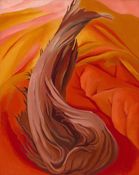
Vertical canvas of vibrant red and orange hills dominated in the foreground by a twisting frayed brown tree stump - a piece of driftwood in a sea of reddish orange.
CR No. 999
Title (1999 Catalogue Raisonné)
Stump in Red Hills
Source of title: Whitney Archive, Downtown Gallery Archive, Abiquiú Notebooks, 1941 New York (An American Place–O'Keeffe) exhibition checklist.
General Remarks
Whitney Archive indicates, "Exam. at Amer. Place, March 1946....No Signature." (Source: Lynes, 1999)
Inscriptions
Stretcher: inaccessible Verso: inaccessible (Source: Lynes, 1999)
Technique
Oil Painting
Materials
Oil on canvas
1986
Hirschl & Adler Galleries
Gerald Peters Gallery
1988–1989
2004–2005
Buffalo AKG Art Museum
Georgia O'Keeffe Museum
Columbus Museum of Art
2008–2009
Smithsonian American Art Museum
Norton Museum of Art
Georgia O'Keeffe Museum
San Francisco Museum of Modern Art (SFMOMA)
2010–2013
Georgia O'Keeffe Museum
National Cowgirl Museum of Hall of Fame
2014–2015
2017–2020
Brooklyn Museum of Art
Reynolda House Museum of American Art
Peabody Essex Museum (as Georgia O'Keeffe: Art, Image, Style)
The Cleveland Museum of Art
Wichita Art Museum (as Georgia O'Keeffe: Art, Image, Style)
Nevada Museum of Art
Norton Museum of Art
2023–2024
(The Downtown Gallery, New York, N.Y.) James A. Michener, Pipersville, Pa., 1961
(The Downtown Gallery, New York, N.Y.)
The artist, 1961 (Doris Bry, New York, N.Y.)
Private collection, White Plains, N.Y., 1969
(Gerald Peters Gallery, Santa Fe, N.Mex.)
Stéphane Janssen and Michael Johns, Santa Fe, N.Mex.
(Source: Georgia O'Keeffe Museum,2026)
© Georgia O'Keeffe Museum
Version History
Core fields last updated 6/10/2026
Last verified by current collection
Source System ID
59
| Date | Field | Changed From | Changed To |
|---|---|---|---|
| mm/dd/yyyy | Artist | Changed from data | Changed to data |
| mm/dd/yyyy | Main title | Changed from data | Changed to data |
| mm/dd/yyyy | Year | Changed from data | Changed to data |
| mm/dd/yyyy | Media | Changed from data | Changed to data |
| mm/dd/yyyy | Credit line | Changed from data | Changed to data |
| mm/dd/yyyy | Provenance | Changed from data | Changed to data |
Conservation
Information is from the most recently submitted report, please contact the current owner to verify updated details.Support: The support is a 1 x 1 twill-weave, processed linen canvas stretched over an "American Type", double-bevel-faced, miter-cut ended, mortise-and-tenon keyable softwood commercial stretcher bar, pre-cut to the whole inch, 1 ¾" wide x ¾" thick in 30" and 24" sized lengths. The canvas is stretched using blued steel tacks spaced evenly apart. Eight keys are extant.
Ground or Support Preparation: The processed linen canvas has a commercially applied primer consisting of 2PbCO3•Pb(OH)2) and CaCO3 or ZnO in oil. These were identified using XRF spectrometry at 15kV and 40kV, with currents of 28 µA and 3 µA, respectively.
Design Layers: The paints have been applied over charcoal/graphite line under-drawing in single layers, such that the twill texture of the primed canvas is often visible through the paint selectively, particularly across the viewer's right half of the composition. Darker, more translucent values in the central stump figure were prepared with fluid, cream consistencies and allowed to flow and level into the texture of the canvas. As the values become brighter and more opaque in all colors, the paints take on a stiffer, paste-like consistency, which retains application textures and covers the canvas texture. O'Keeffe applies paint at the margins of forms using nearly continuous, curvilinear brush strokes with the brush positioned at an angle low to the canvas, resulting in a continuous, raised ridge of paint at the edge of each form. Surrounding brushwork is generally parallel to the linear directions defined by these edges, with no underlying or subsequent brushwork moving perpendicular to the linear form. Occasionally, adjacent forms do not overlap, and the artist has chosen to allow a "holiday" of unpainted, primed canvas to be a visible detail in the composition, with graphite underdrawing residues sometimes visible. The colors in the painting have been characterized by x-ray spectroscopy at 15kV and 40kV and 28µA and 3µA as containing primarily lead red/orange and cadmium sulfide yellow and/or orange, ZnO, and 2PbCO3•Pb(OH)2, white, and small amounts of Fe red ochre/hematite. The brown paints are Fe umbers. Pb soap micro-protrusion degradation appears clearly accelerated by the presence of basic Pb carbonate in the paints, as they are far more numerous and more fully developed, in the collapsed state, in the regions where lead white has been added.
Surface Coating: Records indicate that butyl methacrylate resin was applied by conservator Caroline Keck in 1948. In 2008, the hydrogenated hydrocarbon resin "Regalrez 1094" was selectively applied to adjust the gloss of scratches and saturate areas of inpainting and repair.
Framing, Backing, and Hanging Hardware: The painting is installed in an original Peter Bayle brass "L" profile metal frame. The fit is very tight. The glazing is Optium® titanium-coated, UV-absorbing, static-free, non-reflective acrylic.
All paints appear secure and stable, despite the presence of hairline, intermittent, limited, and superficial cracking in the paints across the viewer's left and center, as well as at the stretcher bar creases.
Between 1948 and 2001, the painting developed a broad series of buckled cracks, perpendicular to the diagonal twill of the canvas, across nearly the entire viewer's left side. Consolidated cracks appear to remain stable, and planar deformations have not been aggravated since 2015. Most of the cracks in the painting are associated with thicker paint applications (often flattened by palette knife), which could not respond elastically to changing canvas kinetic energy loads as a result of handling, vibration, and shock. The cracks have resulted in moderate to heavy quilting of the canvas verso, isolated chip losses, and severe planar distortion.
The work has almost continuous stretcher bar creases with consolidated cracks across the top, bottom, and right sides, with isolated losses. The work has developed a broad, generalized distribution of 200µm diameter (2PbCO3·Pb(OH)2) micro-protrusions that appear under some magnification as small granular surface inclusions in the paints. They are visible in the primed canvas along the tacking edge where there are no paints. They are more numerous and larger in thick paints containing basic lead carbonate white, becoming very small in areas where the addition of white is minimized or absent.
The work also exhibits an opaque, whitish, aluminum stearate bloom of the darkest saturated reds. The stearate was added as a pigment suspending agent by the paint manufacturers and remains in a mobile, waxy phase, particularly when the work is exposed to hot or cold temperature extremes in transit and on airport tarmacs and customs warehouses. The varnish is lightly discolored with lightly embedded soiling. There are generalized tarnishing and edge abrasions from hand contact with the copper-plated, rolled brass frame.
DOWNLOAD IMAGE
Terms of use
The Georgia O'Keeffe Museum is dedicated to fostering access to its collections to inspire education, research, and creative engagement. Through Access O'Keeffe, the Museum’s digital catalogue raisonné project, we provide free tools for engaging with Georgia O'Keeffe’s full body of work. As part of this initiative, we encourage the download of low-resolution images for educational and fair use purposes.
Certain works by Georgia O'Keeffe are under the copyright of the Georgia O'Keeffe Museum, while others are managed by different rights holders. For commercial uses, users must seek authorization directly from the respective copyright holder.
By downloading and using these images, users agree to the following terms and conditions of use including the Museum’s reproduction guidelines. Users will play a vital role in preserving the integrity of the artist’s work while supporting broader public access.
Permitted Uses
Fair Use:
Images may be used under fair use principles for purposes such as:
- Educational: Use in teaching materials, presentations, and coursework
- Research and scholarship: Academic research articles, theses, dissertations and noncommercial publications
- Creative projects: Reference or inspiration for personal artwork, such as sketches, paintings, or digital art, if the works are not sold or used commercially.
Conditions of Use
By downloading images of artwork from Access O'Keeffe, users agree to adhere to the Museum’s reproduction guidelines for artwork by Georgia O'Keeffe. Images must not be altered, manipulated, or modified in any way that compromises their integrity or misrepresents the original work. Specifically, artworks may not be cropped, distorted, or subjected to the following alterations:
- Cropping
- Rotation, inversion, or changes to the original proportions
- Color adjustments
- Superimposition of text, graphics, or other elements
- Animation, cartooning, or other forms of reinterpretation
- Removal or modification of blemishes, inscriptions, or other original features
- Printing artwork on 3D materials, including fabrics
Unauthorized Uses
Unauthorized uses of Georgia O'Keeffe’s works include any applications that fall outside the scope of fair use, such as those intended for commercial profit generating purposes.
Examples include, but are not limited to:
- Publications and merchandise that are sold or generate income.
- Reproductions in marketing materials, advertisements, or promotional campaigns.
- Use in exhibitions or displays that charge admission fees.
For any such uses, prior written authorization must be obtained from the appropriate copyright holder noted in Access O'Keeffe.
For any commercial use, prior written permission is required from the copyright holder. Please contact the Digital Experience and Rights Manager at [email protected]
ADD TO LIST
COPY CITATION
Georgia O'Keeffe. Stump in Red Hills, 1940. Access O’Keeffe, Georgia O’Keeffe Museum, https://access-ok.okeeffemuseum.org/object/59.