|
Oil on canvas, 36 1/16 x 30 1/8 inches
CR No. 462
|
Gift of The Burnett Foundation and Gerald and Kathleen Peters
1996.3.2
|
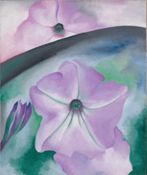
Large lavender-purple flower in center foreground with dark arc above. Purple flower buds lower left. The diagonal arc is concealing the lower part of a second purple flower in upper half of painting.
CR No. 462
Title (1999 Catalogue Raisonné)
Petunia No. 2
Source of title: Whitney Archive.
Alternate Title (1999 Catalogue Raisonné)
Petunia #2
Source of title: Downtown Gallery Archive, Abiquiú Notebooks.
Petunia – No. II
Source of title: Downtown Gallery Archive, Abiquiú Notebooks.
Petunia No. II
Source of title: Downtown Gallery Archive, Abiquiú Notebooks.
Selected Exhibition Titles
Petunia II
Inaugural Exhibition, 1997, Georgia O'Keeffe Museum (Santa Fe)
Petunia II
An Expanding Collection, 1998, Georgia O'Keeffe Museum (Santa Fe)
Petunia II
Georgia O'Keeffe: The Poetry of Things, 1999, Georgia O'Keeffe Museum (Santa Fe)
Petunia II
Georgia O'Keeffe: The Poetry of Things, 1999, Dallas Museum of Art (Dallas)
Petunia II
Georgia O'Keeffe: The Poetry of Things, 1999, The Phillips Collection (Washington, D.C.)
General Remarks
Whitney Archive, Abiquiú Notebooks indicate "Exam. at Amer. Place, March 1946....No signature" [note of backing inscription 2 with "No. 2" but identifies it as by O'Keeffe]. (Source: Lynes, 1999)
Inscriptions
Inscriptions: Backing:
- OK {5star} (graphite)
- "Petunia...[number torn away]/by Georgia O'Keeffe / 1924 / #122 Catalogue / Exhib. 7 Americans - 1925" (Alfred Stieglitz, graphite)
- "$6000" (Alfred Stieglitz, black crayon)
- "For Cleveland" (Alfred Stieglitz, graphite)
- "Petunia #2 / Georgia O'Keeffe / 1924" (Alfred Stieglitz, Label: handwritten, "An American Place' / 509 Madison Avenue / New York — N.Y. / Georgia O'Keeffe" black crayon) Stretcher: none Verso: none (Source: Lynes, 1999)
Technique
Oil Painting
Materials
Oil on canvas
1993–1994
Hayward Gallery
Museo del Palacio de Bellas Artes
Yokohama Museum of Art
1997–1998
1998–1999
1999–2000
Georgia O'Keeffe Museum
Dallas Museum of Art
The Phillips Collection
Fine Arts Museums of San Francisco
2003–2004
2006
Mississippi Museum of Art
Georgia O'Keeffe Museum
Memorial Art Gallery of the University of Rochester (MAG)
2008–2009
Georgia O'Keeffe Museum
Amon Carter Museum of American Art
San Jose Museum of Art
2008–2009
Smithsonian American Art Museum
Norton Museum of Art
Georgia O'Keeffe Museum
San Francisco Museum of Modern Art (SFMOMA)
2011–2012
2013–2014
Hyde Collection Art Museum
Georgia O'Keeffe Museum
Fine Arts Museums of San Francisco
2016–2017
Heide Museum of Modern Art
Art Gallery of New South Wales
Queensland Art Gallery / Gallery of Modern Art
2017–2019
2018–2019
2019
2019–2020
2020–2021
(Doris Bry, New York, N.Y.)
Anita O'Keeffe (Mrs. Robert R.) Young, Newport, R.I., 1972
Estate of Anita O'Keeffe (Mrs. Robert R.) Young, 1985
Robert R. Young Foundation, Cincinnati, Ohio, 1985
Sotheby's, New York, N.Y., sale no. 5658, lot no. 1, 3 December 1987
Gerald and Kathleen Peters, Santa Fe, N.Mex., 1989
The Burnett Foundation, Fort Worth, Tex., 1995 (partial share)
Gift to the Georgia O'Keeffe Museum, 1996
(Source: Georgia O'Keeffe Museum, 2026)
© Georgia O'Keeffe Museum
Version History
Core fields last updated 8/26/2026
Last verified by current collection
Source System ID
4
| Date | Field | Changed From | Changed To |
|---|---|---|---|
| mm/dd/yyyy | Artist | Changed from data | Changed to data |
| mm/dd/yyyy | Main title | Changed from data | Changed to data |
| mm/dd/yyyy | Year | Changed from data | Changed to data |
| mm/dd/yyyy | Media | Changed from data | Changed to data |
| mm/dd/yyyy | Credit line | Changed from data | Changed to data |
| mm/dd/yyyy | Provenance | Changed from data | Changed to data |
Conservation
Information is from the most recently submitted report, please contact the current owner to verify updated details.Support: The support is a commercially primed, fine, plain-weave, bleached linen canvas. At an unknown date, using techniques consistent with work done under the direction of the artist and conservator Fel Hines, the work was lined onto a Belgian linen canvas with a wax-resin mixture. The canvas was mounted onto a new expansion bolt strainer, as it remains at present.
Ground or Support Preparation: Commercial protein sizing and apparent zinc oxide/lead white in oil primer.
Design Layers: Graphite underdrawing occasionally visible at the raised ridges of paint between the edges of adjacent linear forms. There are single-layer, thinly applied paints with support texture visible throughout. Whites and light values are often applied with stiff paints using short, scrubbing brush strokes. Darker values, cream, and vehicular paints, nearly smooth and leveled, were applied using linear brushwork at the margins of forms, with raised ridges of paint at the edges of the forms. There are gradual, stepped transitions in value or hue, generally painted wet into dry.
Surface Coating: The work appears to be coated with the original, synthetic resin sprayed on at the artist's direction. The varnish appears slightly soiled and yellowed, overall, with broadly distributed, dark-amber-colored inclusions.
Framing, Backing, and Hanging Hardware: The work is framed in a contemporary, micro-environmentally buffered, and gasketed metal-leaf "clam shell" profile frame, a reproduction of Georgia O'Keeffe's original design, created by framer/artist George Of. The glazing is Optium® tin salt-coated UV-absorbing, static-free, non-reflective acrylic. The Optium glazing has a Volora closed-cell polyethylene gasket/pad. The frame is fitted with a laminated, Voloro-gasketed backing strainer.
The work is complete, and the media is stable overall. The work has suffered historic planar distortions, age, drying cracks, and interlayer cleavage, which was likely the focus of the wax-resin lining of the work to a secondary linen canvas and expansion bolt strainer. The possibility exists that the lining treatment exacerbated several significant deterioration conditions.
The work has stretcher bar creases and associated, branched hairline cracks on the inside of all four stretcher rails. Warps threads in the original canvas appear to have been thrust forward onto the recto relief by the lining process, and a number of cracks may have formed or been aggravated by this action. Further, stiff, paste-like points containing whites have frequent drying cracks, and these may have been aggravated or widened by the tension of the lining fabric.
There is a series of cracks at the center of the top stretcher rail that were originally caused by a handhold and careless protrusion of fingers into the verso of the canvas. The cracks in this area continue to actively cleave and buckle, requiring ongoing consolidation. Likewise, stretcher bar cracks continue to cleave and lift, requiring periodic consolidation.
The glossy, synthetic varnish on the work appears to have tiny, dark-amber, translucent inclusions that are partially dissolved and diffused by the varnish or its original carrier solvent, suggesting that the air-hose, compressor, or spray apparatus introduced these contaminants generally over the entire varnish coating on the work. There is a broad planar depression in the lower-left quadrant.
DOWNLOAD IMAGE
Terms of use
The Georgia O'Keeffe Museum is dedicated to fostering access to its collections to inspire education, research, and creative engagement. Through Access O'Keeffe, the Museum’s digital catalogue raisonné project, we provide free tools for engaging with Georgia O'Keeffe’s full body of work. As part of this initiative, we encourage the download of low-resolution images for educational and fair use purposes.
Certain works by Georgia O'Keeffe are under the copyright of the Georgia O'Keeffe Museum, while others are managed by different rights holders. For commercial uses, users must seek authorization directly from the respective copyright holder.
By downloading and using these images, users agree to the following terms and conditions of use including the Museum’s reproduction guidelines. Users will play a vital role in preserving the integrity of the artist’s work while supporting broader public access.
Permitted Uses
Fair Use:
Images may be used under fair use principles for purposes such as:
- Educational: Use in teaching materials, presentations, and coursework
- Research and scholarship: Academic research articles, theses, dissertations and noncommercial publications
- Creative projects: Reference or inspiration for personal artwork, such as sketches, paintings, or digital art, if the works are not sold or used commercially.
Conditions of Use
By downloading images of artwork from Access O'Keeffe, users agree to adhere to the Museum’s reproduction guidelines for artwork by Georgia O'Keeffe. Images must not be altered, manipulated, or modified in any way that compromises their integrity or misrepresents the original work. Specifically, artworks may not be cropped, distorted, or subjected to the following alterations:
- Cropping
- Rotation, inversion, or changes to the original proportions
- Color adjustments
- Superimposition of text, graphics, or other elements
- Animation, cartooning, or other forms of reinterpretation
- Removal or modification of blemishes, inscriptions, or other original features
- Printing artwork on 3D materials, including fabrics
Unauthorized Uses
Unauthorized uses of Georgia O'Keeffe’s works include any applications that fall outside the scope of fair use, such as those intended for commercial profit generating purposes.
Examples include, but are not limited to:
- Publications and merchandise that are sold or generate income.
- Reproductions in marketing materials, advertisements, or promotional campaigns.
- Use in exhibitions or displays that charge admission fees.
For any such uses, prior written authorization must be obtained from the appropriate copyright holder noted in Access O'Keeffe.
For any commercial use, prior written permission is required from the copyright holder. Please contact the Digital Experience and Rights Manager at [email protected]
ADD TO LIST
COPY CITATION
Georgia O'Keeffe. Petunia No. 2, 1924. Access O’Keeffe, Georgia O’Keeffe Museum, https://access-ok.okeeffemuseum.org/object/4.