|
Oil on canvas, 41 1/2 x 31 3/8 in (105.4 x 79.7 cm) ^41 5/8 x 31 1/2 in framed dims
CR No. 1360
|
Gift of The Georgia O'Keeffe Foundation
2006.5.280
|
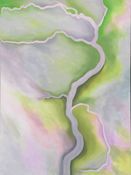
A light-colored serpentine river winds its way vertically through the canvas, with several smaller streams breaking off along the way. The banks of the river are highlighted by shades of yellow, while much of the remaining landscape is pale in color.
CR No. 1360
Title (1999 Catalogue Raisonné)
From the River – Pale
Source of title: Abiquiú Notebooks after 1977.
General Remarks
Not recorded Whitney Archive, Downtown Gallery Archive. The subject matter of the work is a stick O'Keeffe found near the river, which stands on a table next to her easel and the finished painting in a 1963 Todd Webb photograph; see Charles Eldredge (Georgia O'Keeffe: American and Modern [1993], p. 37). (Source: Lynes, 1999)
Inscriptions
Stretcher: inaccessible Verso: inaccessible (Source: Lynes, 1999)
Technique
Oil Painting
Materials
Oil on canvas
2008–2009
Portland Museum of Art (Maine)
Georgia O'Keeffe Museum
2016–2017
2019
2019–2020
2020–2021
2024–2025
San Diego Museum of Art
Albuquerque Museum
Musee Des Beaux-Arts Montreal
Museum of Fine Arts (MFA Boston)
Estate of the artist, 1986
Georgia O’Keeffe Foundation, 1993
Gift to Georgia O’Keeffe Museum, 2006
(Source: Georgia O'Keeffe Museum, 2025)
© Georgia O'Keeffe Museum
Version History
Core fields last updated 10/15/2026
Last verified by current collection
Source System ID
1049
| Date | Field | Changed From | Changed To |
|---|---|---|---|
| mm/dd/yyyy | Artist | Changed from data | Changed to data |
| mm/dd/yyyy | Main title | Changed from data | Changed to data |
| mm/dd/yyyy | Year | Changed from data | Changed to data |
| mm/dd/yyyy | Media | Changed from data | Changed to data |
| mm/dd/yyyy | Credit line | Changed from data | Changed to data |
| mm/dd/yyyy | Provenance | Changed from data | Changed to data |
Conservation
Information is from the most recently submitted report, please contact the current owner to verify updated details.Support: The support is a 2 x 2, bleached linen, closed, basket-weave with vertical warp thread orientation. The canvas was stretched over a 2 ½" wide, mortise-and-tenon, miter-corner, hardwood stretcher with large cardboard triangles nailed to each of the four corners to keep the stretcher taut and square. There are no stretcher crossbars.
Ground or Support Preparation: The processed linen canvas has an artist-applied white primer appearing similar to that of roughly equal parts 2PbCO3•Pb(OH)2 and ZnO in oil. The primer was applied over a sizing of rabbit-skin glue, which appears thickly applied in isolated areas. Thin, graphite underdrawing is frequently visible at the unpainted margins between the forms.
Design Layers: The paints have been applied over charcoal/graphite line under-drawing in single layers, such that the texture of the primed canvas is visible through the paint, and the canvas or primer functions as a reflective surface. The artist has prepared her higher-value whites and lighter colors to have a slightly stiff consistency, which retains brush texture as a compositional and textural effect. Darker values, by contrast, were prepared with more fluid, cream consistencies and allowed to flow and level into the texture of the canvas. O'Keeffe applies paint at the margins of forms using nearly continuous, curvilinear brush strokes with the brush positioned at a low angle to the canvas, resulting in a continuous, raised ridge of paint at the edge of each form. Surrounding brushwork is generally parallel to the linear directions defined by these edges, with no underlying or subsequent brushwork moving perpendicular to the linear form. Occasionally, adjacent forms do not overlap, and the artist has chosen to allow a "holiday" of unpainted, primed canvas to be a visible detail in the composition, with graphite underdrawing residues sometimes visible. The artist has also used subtractive techniques to thin paint and allow the white-primed canvas below to take on a more prominent visual character.
Surface Coating: The painting has a thin, slightly yellowed and soiled, synthetic acrylic varnish, apparently an isobutyl methacrylate.
XRF: Primer stretched and primed by Georgia O'Keeffe.
Right edge: lead carbonate, zinc oxide, tiny bit of calcium, tiny bit of titanium.
Lower right corner, intense green: viridian green, barium, cadmium yellow, lead carbonate, zinc oxide.
Middle left side, violet/purple: Cobalt, zinc, arsenic (Cobalt arsenate).
Lower left side, pink: Cobalt, zinc.
Bottom edge, center, blue: Cobalt, no iron, no silica, viridian green, tiny bit of cadmium (yellow).
Center, dark green: cadmium (yellow), lead, sulfur, barium white, iron Prussian blue, zinc white, no chrome, no cobalt.
Right side, between 2 pink vertical lines: zinc, synthetic alizarin.
Soaps: Very few, very small, most numerous in viridian green.
Framing, Backing, and Hanging Hardware: The work is framed in a contemporary reproduction of an original Georgia O'Keeffe/George Of-designed Metalleaf, "clam shell" profile frame. The frame interior is fitted with Artsorb felt and Microchamber boards that buffer the interior conditions around a 45% RH setpoint and absorb acidic and oxidative VOCs generated by the original materials. The verso and recto are individually gasketed to form sealed air volumes on both sides, damping vibration and canvas displacement from transport and handling. The glazing is Optium® tin salt-coated, UV-absorbing, static-free, non-reflective acrylic. The Optium glazing has a Volara closed-cell polyethylene gasket/pad. The frame is fitted with a laminated, Volara-gasketed backing strainer which has Security mirror-hanger and T-bolt hardware as well as D-rings.
All paints appear secure and stable. There are frame abrasions along all four edges of the painting face where the work historically rested against the rabbet of Georgia O'Keeffe's original frame, and these are also normally expected in O'Keeffe's works from this period. The paints in these edges are also stable and secure. The work is planar and taut, but there is a very slight stretcher bar crease on the inside edge of the top stretcher bar, to the viewer's right of center. There are isolated insect accretions on the surface, but these appear to be easily removed. There are many holidays at the margins between forms where paints do not overlap and the primed canvas is visible; these should not be mistaken for losses or deterioration. There are isolated, pinpoint losses at the interstices of the weave, and these may be the result of transit vibrations. They are characterized by their sharp, fractured edges at the margins of the loss. One portion of the artist's typical linear, raised ridges of paint at the edges of forms has cleaved and is lost near the upper viewer's left corner. These ridges should be examined across the entire work after each transit to determine if there are other losses as a result of kinetic energy inputs.
DOWNLOAD IMAGE
Terms of use
The Georgia O'Keeffe Museum is dedicated to fostering access to its collections to inspire education, research, and creative engagement. Through Access O'Keeffe, the Museum’s digital catalogue raisonné project, we provide free tools for engaging with Georgia O'Keeffe’s full body of work. As part of this initiative, we encourage the download of low-resolution images for educational and fair use purposes.
Certain works by Georgia O'Keeffe are under the copyright of the Georgia O'Keeffe Museum, while others are managed by different rights holders. For commercial uses, users must seek authorization directly from the respective copyright holder.
By downloading and using these images, users agree to the following terms and conditions of use including the Museum’s reproduction guidelines. Users will play a vital role in preserving the integrity of the artist’s work while supporting broader public access.
Permitted Uses
Fair Use:
Images may be used under fair use principles for purposes such as:
- Educational: Use in teaching materials, presentations, and coursework
- Research and scholarship: Academic research articles, theses, dissertations and noncommercial publications
- Creative projects: Reference or inspiration for personal artwork, such as sketches, paintings, or digital art, if the works are not sold or used commercially.
Conditions of Use
By downloading images of artwork from Access O'Keeffe, users agree to adhere to the Museum’s reproduction guidelines for artwork by Georgia O'Keeffe. Images must not be altered, manipulated, or modified in any way that compromises their integrity or misrepresents the original work. Specifically, artworks may not be cropped, distorted, or subjected to the following alterations:
- Cropping
- Rotation, inversion, or changes to the original proportions
- Color adjustments
- Superimposition of text, graphics, or other elements
- Animation, cartooning, or other forms of reinterpretation
- Removal or modification of blemishes, inscriptions, or other original features
- Printing artwork on 3D materials, including fabrics
Unauthorized Uses
Unauthorized uses of Georgia O'Keeffe’s works include any applications that fall outside the scope of fair use, such as those intended for commercial profit generating purposes.
Examples include, but are not limited to:
- Publications and merchandise that are sold or generate income.
- Reproductions in marketing materials, advertisements, or promotional campaigns.
- Use in exhibitions or displays that charge admission fees.
For any such uses, prior written authorization must be obtained from the appropriate copyright holder noted in Access O'Keeffe.
For any commercial use, prior written permission is required from the copyright holder. Please contact the Digital Experience and Rights Manager at [email protected]
ADD TO LIST
COPY CITATION
Georgia O'Keeffe. From the River – Pale, 1959. Access O’Keeffe, Georgia O’Keeffe Museum, https://access-ok.okeeffemuseum.org/object/1049.