|
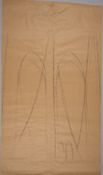
Charcoal on brown paper, 62 7/8 x 36 inches
CR No. 1170
|
Gift of Doris Bry
|
The pointed arches of the Brooklyn Bridge rise through the center of this minimalist sketch. A second set of arches appears in the distance.
CR No. 1170
Title (1999 Catalogue Raisonné)
Brooklyn Bridge
Source of title: Recto inscription.
Alternate Title
Preparatory Study for Brooklyn Bridge
Source of title: Brooklyn Museum.
General Remarks
Not recorded Whitney Archive, Downtown Gallery Archive, Abiquiú Notebooks. (Source: Lynes, 1999)
Inscriptions
Recto: "Brooklyn Bridge 49 — Not very good" (graphite) (Source: Lynes, 1999)
Technique
Drawing
Materials
Charcoal on brown paper
Doris Bry, New York, N.Y., 1978, Brooklyn Museum (The), 1998; provenance likely incomplete (Source: Brooklyn Museum of Art, 2025)
© Georgia O'Keeffe Museum
Version History
Core fields last updated 8/26/2026
Last verified by current collection 2025
Source System ID
10181
| Date | Field | Changed From | Changed To |
|---|---|---|---|
| mm/dd/yyyy | Artist | Changed from data | Changed to data |
| mm/dd/yyyy | Main title | Changed from data | Changed to data |
| mm/dd/yyyy | Year | Changed from data | Changed to data |
| mm/dd/yyyy | Media | Changed from data | Changed to data |
| mm/dd/yyyy | Credit line | Changed from data | Changed to data |
| mm/dd/yyyy | Provenance | Changed from data | Changed to data |
Conservation
Information is from the most recently submitted report, please contact the current owner to verify updated details.Information provided for Access O'Keeffe by Brooklyn Museum of Art in 2025.
Good
The object is in good and stable condition. The object is a preparatory sketch for the painting Brooklyn Bridge (77.11), also in the museum's collection. Horizontal creases near the upper edge of the sheet may have been created when the sheet was attached to a drawing board or possibly the painting's masonite panel as a means to transfer the friable drawing media to the primed panel. A myriad of creases down the center vertical axis of the sheet may have been created by the artist if she folded the paper in half lengthwise, to transfer the design from one half of hte sheet to the other, for symmetry. Another possible theory is that the creases were created due to repetative folding the sheet to transfer the composition to the primed masonite panel. Horizontal creases throughout the sheet may have been created when the drawing was rolled in storage or may also be related to the artist's process. Two small punctures near each of the upper corners suggest the drawing was pinned to a surface. There are six strips of Japanese paper on the verso from a previous hinging campaign: two along the upper edge of the sheet, near the corners; two along the left edge; and two along the right edge. Abrasions and residual adhesive in two areas just above the center of the verso appear to have been created by tape, now removed.
DOWNLOAD IMAGE
Terms of use
The Georgia O'Keeffe Museum is dedicated to fostering access to its collections to inspire education, research, and creative engagement. Through Access O'Keeffe, the Museum’s digital catalogue raisonné project, we provide free tools for engaging with Georgia O'Keeffe’s full body of work. As part of this initiative, we encourage the download of low-resolution images for educational and fair use purposes.
Certain works by Georgia O'Keeffe are under the copyright of the Georgia O'Keeffe Museum, while others are managed by different rights holders. For commercial uses, users must seek authorization directly from the respective copyright holder.
By downloading and using these images, users agree to the following terms and conditions of use including the Museum’s reproduction guidelines. Users will play a vital role in preserving the integrity of the artist’s work while supporting broader public access.
Permitted Uses
Fair Use:
Images may be used under fair use principles for purposes such as:
- Educational: Use in teaching materials, presentations, and coursework
- Research and scholarship: Academic research articles, theses, dissertations and noncommercial publications
- Creative projects: Reference or inspiration for personal artwork, such as sketches, paintings, or digital art, if the works are not sold or used commercially.
Conditions of Use
By downloading images of artwork from Access O'Keeffe, users agree to adhere to the Museum’s reproduction guidelines for artwork by Georgia O'Keeffe. Images must not be altered, manipulated, or modified in any way that compromises their integrity or misrepresents the original work. Specifically, artworks may not be cropped, distorted, or subjected to the following alterations:
- Cropping
- Rotation, inversion, or changes to the original proportions
- Color adjustments
- Superimposition of text, graphics, or other elements
- Animation, cartooning, or other forms of reinterpretation
- Removal or modification of blemishes, inscriptions, or other original features
- Printing artwork on 3D materials, including fabrics
Unauthorized Uses
Unauthorized uses of Georgia O'Keeffe’s works include any applications that fall outside the scope of fair use, such as those intended for commercial profit generating purposes.
Examples include, but are not limited to:
- Publications and merchandise that are sold or generate income.
- Reproductions in marketing materials, advertisements, or promotional campaigns.
- Use in exhibitions or displays that charge admission fees.
For any such uses, prior written authorization must be obtained from the appropriate copyright holder noted in Access O'Keeffe.
For any commercial use, prior written permission is required from the copyright holder. Please contact the Digital Experience and Rights Manager at [email protected]
ADD TO LIST
COPY CITATION
Georgia O'Keeffe. Brooklyn Bridge, 1949. Access O’Keeffe, Georgia O’Keeffe Museum, https://access-ok.okeeffemuseum.org/object/10181.