|
Oil on board, 8 1/2 x 13 9/16 inches
CR No. 857
|
Gift of The Georgia O'Keeffe Foundation
2006.5.147
|
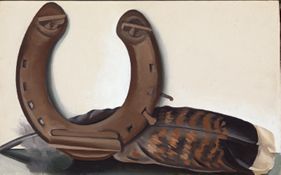
A horseshoe stands upright on the left side of the work with its open end facing upward. A feather lies behind the horseshoe and along the surface upon which both objects rest. The surface reflects a bit of the feather on the left end.
CR No. 857
Title (1999 Catalogue Raisonné)
Horseshoe with Feather No. I
Source of title: backing inscription 1.
Alternate Title (1999 Catalogue Raisonné)
Turkey Feather with Horseshoe, I
Source of title: Whitney Archive, Downtown Gallery Archive, Abiquiú Notebooks.
Turkey Feather with Horseshoe I
Source of title: Whitney Archive, Downtown Gallery Archive, Abiquiú Notebooks.
General Remarks
Whitney Archive indicates, "Exam at amer. Place, March 1946" [notes inscription 1]. Abiquiú Notebooks notes inscription 2. Reproduced and titled Turkey Feather with Horseshoe, I, in The Springfield Sunday Union and Republican (January 1936). (Source: Lynes, 1999)
Inscriptions
Inscriptions: Backing:
- "Horse Shoe with Feather No I -35" (graphite)
- OK {5star} (graphite) (Source: Lynes, 1999)
Technique
Oil Painting
Materials
Oil on board
2012–2014
Montclair Art Museum
Denver Art Museum
Georgia O'Keeffe Museum
Heard Museum
2014–2016
Indianapolis Museum of Art
Art Museum of South Texas
Colorado Springs Fine Arts Center at Colorado College
Tacoma Art Museum
Estate of the artist, 1986
Georgia O’Keeffe Foundation, 1993
Gift to Georgia O’Keeffe Museum, 2006
(Source: Georgia O'Keeffe Museum, 2025)
© Georgia O'Keeffe Museum
Version History
Core fields last updated 8/26/2026
Last verified by current collection
Source System ID
1010
| Date | Field | Changed From | Changed To |
|---|---|---|---|
| mm/dd/yyyy | Artist | Changed from data | Changed to data |
| mm/dd/yyyy | Main title | Changed from data | Changed to data |
| mm/dd/yyyy | Year | Changed from data | Changed to data |
| mm/dd/yyyy | Media | Changed from data | Changed to data |
| mm/dd/yyyy | Credit line | Changed from data | Changed to data |
| mm/dd/yyyy | Provenance | Changed from data | Changed to data |
Conservation
Information is from the most recently submitted report, please contact the current owner to verify updated details.Support: The work is executed on a laminated, composite cardboard panel. Small indentations at the board edges indicate the painting was likely previously installed in a frame using nails. Small bits of the paper structure are easily dislodged.
Ground or Support Preparation: The priming on the recto appears to be basic lead carbonate in oil, as identified using XRF at 15 kV, 28.8 μA, and 40 kV, 3.8 μA, with full vacuum. There is a coating of titanium dioxide white magna color on the verso, applied in 1975 at the request of the artist. Below this coating, red, green, grey, and blue paint, likely oil-based, can be seen, and these paints have a tendency to shed small bits of paint. The priming appears to have been applied by the artist and is a white ground of lead carbonate in oil. The priming appears generally secure and stable and can be seen intermittently on the board edges. Flaking of the paper from the support and small colored paint bits from under the white coating on the verso tend to easily flake, while some bits appear to be stuck to the verso surface. The white acrylic coating has flaked, leaving the colored paints exposed at the edges.
Design Layers: Paints are generally thinly applied in single and double layers as creams and liquids, executing transitions in value or hue by painting wet–abutting dry. The artist has raised ridges of paint with her brushwork at the edges of many forms. Background whites were smoothed by the artist using a palette knife or a similar tool. Graphite underdrawing is occasionally visible at the edges of forms in both holidays between and under paint application. Small bumps/micro-protrusions are present (primarily in green or variations of green) on the surface and indicate the presence of soaps. Paints have been preliminarily characterized using X-ray fluorescence as basic lead carbonate and zinc oxide whites, bone black, burnt umber, red ochre, yellow ochre, and viridian chrome green, all in drying oil.
Surface Coating: A yellowed and lightly soiled synthetic resin varnish, thickly brush-applied, is present overall. Treatment documentation suggests that the work was last varnished in 1975 using Acryloid B-67 iso- and n-butyl methacrylate copolymer. Localized consolidation of the fragmented panel edges was also executed at this time, as was the removal and overpainting of a painting on the verso, at the request of the artist.
Framing, Backing, and Hanging Hardware: The work is installed in a reproduction Georgia O'Keeffe III "clam shell" profile metal leaf, environmentally controlled frame with a gasketed secondary backing basswood strainer and gasketed Optium glazing.
With the exception of some paint flake loss at the edges of the support (and paints on the verso as noted above in the section on ground/support preparation), all paints appear secure and stable. The support is in good plane overall. There are numerous scattered holidays in the paint layer as a result of the artist's compositional technique. These should not be mistaken for losses. There is a shallow, linear abrasion in the varnish across the lower left of the horseshoe, near the tip of the feather (near the black edge), and at isolated areas on the top and bottom edges. A loss at the mid-left edge of the support has resulted in a small associated crack in the paint at the left edge. Some of the white areas that the artist smoothed with a palette knife or similar suggest a darker color below.
There are isolated accretions and inclusions. Basic lead carbonate micro-protrusion grains and micro-blisters (2PbCO3·Pb(OH)2) have begun to appear, primarily in areas (lower part of painting) containing green paint, but these are very difficult to see, even in strong raking light.
DOWNLOAD IMAGE
Terms of use
The Georgia O'Keeffe Museum is dedicated to fostering access to its collections to inspire education, research, and creative engagement. Through Access O'Keeffe, the Museum’s digital catalogue raisonné project, we provide free tools for engaging with Georgia O'Keeffe’s full body of work. As part of this initiative, we encourage the download of low-resolution images for educational and fair use purposes.
Certain works by Georgia O'Keeffe are under the copyright of the Georgia O'Keeffe Museum, while others are managed by different rights holders. For commercial uses, users must seek authorization directly from the respective copyright holder.
By downloading and using these images, users agree to the following terms and conditions of use including the Museum’s reproduction guidelines. Users will play a vital role in preserving the integrity of the artist’s work while supporting broader public access.
Permitted Uses
Fair Use:
Images may be used under fair use principles for purposes such as:
- Educational: Use in teaching materials, presentations, and coursework
- Research and scholarship: Academic research articles, theses, dissertations and noncommercial publications
- Creative projects: Reference or inspiration for personal artwork, such as sketches, paintings, or digital art, if the works are not sold or used commercially.
Conditions of Use
By downloading images of artwork from Access O'Keeffe, users agree to adhere to the Museum’s reproduction guidelines for artwork by Georgia O'Keeffe. Images must not be altered, manipulated, or modified in any way that compromises their integrity or misrepresents the original work. Specifically, artworks may not be cropped, distorted, or subjected to the following alterations:
- Cropping
- Rotation, inversion, or changes to the original proportions
- Color adjustments
- Superimposition of text, graphics, or other elements
- Animation, cartooning, or other forms of reinterpretation
- Removal or modification of blemishes, inscriptions, or other original features
- Printing artwork on 3D materials, including fabrics
Unauthorized Uses
Unauthorized uses of Georgia O'Keeffe’s works include any applications that fall outside the scope of fair use, such as those intended for commercial profit generating purposes.
Examples include, but are not limited to:
- Publications and merchandise that are sold or generate income.
- Reproductions in marketing materials, advertisements, or promotional campaigns.
- Use in exhibitions or displays that charge admission fees.
For any such uses, prior written authorization must be obtained from the appropriate copyright holder noted in Access O'Keeffe.
For any commercial use, prior written permission is required from the copyright holder. Please contact the Digital Experience and Rights Manager at [email protected]
ADD TO LIST
COPY CITATION
Georgia O'Keeffe. Horseshoe with Feather No. I, 1935. Access O’Keeffe, Georgia O’Keeffe Museum, https://access-ok.okeeffemuseum.org/object/1010.