|
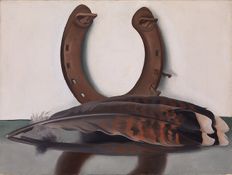
Oil on canvas, 12 3/16 x 16 inches
CR No. 856
|
Gift of The Georgia O'Keeffe Foundation
2006.5.146
|
A horseshoe stands in the center of the work with its open end facing up. A feather lies in front of the horseshoe. Both objects rest on a shiny surface upon which their reflections can be seen.
CR No. 856
Title (1999 Catalogue Raisonné)
Turkey Feather with Horseshoe, II
Source of title: Whitney Archive, Downtown Gallery Archive, 1936 New York (An American Place) exhibition checklist.
Alternate Title (1999 Catalogue Raisonné)
Horseshoe and Feathers #2
Source of title: Downtown Gallery label.
Turkey Feather with Horseshoe – II
Source of title: Abiquiú Notebooks.
General Remarks
Whitney Archive indicates, "Exam. at Amer. Place, March 1946.... No signature." (Source: Lynes, 1999)
Inscriptions
Stretcher: inaccessible Verso: inaccessible (Source: Lynes, 1999)
Technique
Oil Painting
Materials
Oil on canvas
1953
2012–2014
Montclair Art Museum
Denver Art Museum
Georgia O'Keeffe Museum
Heard Museum
2018–2019
Crystal Bridges Museum of American Art
North Carolina Museum of Art
New Britain Museum of American Art
2024–2025
San Diego Museum of Art
Albuquerque Museum
Musee Des Beaux-Arts Montreal
Museum of Fine Arts (MFA Boston)
Estate of the artist, 1986
Georgia O’Keeffe Foundation, 1993
Gift to Georgia O’Keeffe Museum, 2006
(Source: Georgia O'Keeffe Museum, 2025)
© Georgia O'Keeffe Museum
Version History
Core fields last updated 8/26/2026
Last verified by current collection
Source System ID
1009
| Date | Field | Changed From | Changed To |
|---|---|---|---|
| mm/dd/yyyy | Artist | Changed from data | Changed to data |
| mm/dd/yyyy | Main title | Changed from data | Changed to data |
| mm/dd/yyyy | Year | Changed from data | Changed to data |
| mm/dd/yyyy | Media | Changed from data | Changed to data |
| mm/dd/yyyy | Credit line | Changed from data | Changed to data |
| mm/dd/yyyy | Provenance | Changed from data | Changed to data |
Conservation
Information is from the most recently submitted report, please contact the current owner to verify updated details.Support: The original support is a plain weave, 2 x 2, polished linen canvas, having approximately 30 warp and weft thread pairs per inch. Documentation suggests that conservator Caroline Keck likely executed the wax lining of this work on a secondary, 2 x 2 plain-weave canvas around 1958.
Ground or Support Preparation: The raw canvas appears to have been given a very dilute protein sizing and was primed by the artist with a dilute single coat of commercial white pigment in oil, consisting exclusively of Zn, Ca, and S. That may have been followed by a heavy, bright, lead-white overall coating over the recto, but excluding the tacking edges. It is also possible that the heavy lead white coating overall is part of the design layer. A selvedge edge of the canvas is visible on the top tacking edge of the painting, with the warps oriented horizontally.
Design Layers: Graphite underdrawing is occasionally visible under magnification in areas where the paints of adjacent forms do not overlap, indicating that the general forms were underdrawn. Paints are generally applied in single, thin layers, often smoothed with a palette knife in the white background regions, with the canvas weave surface texture often visible. Brush textures remain part of the painterly effect in the foreground, feather, and reflection forms. The margins of forms often display raised, elongated ridges of a defining brushstroke. Paint pigments were characterized using the Bruker III-V XRF spectrometer at full vacuum, with settings of 15 kV, 4 μA, and 40 kV, 29 μA, respectively. The bright whites in the background were characterized as Zn and Pb whites. Foreground greenish gray was characterized as viridian Cr green blended with Zn. While a dark brown or red is suspected in the paint mix, there were no signals of Fe, Cd, or Hg. The bright feather tip whites were characterized and Pb with some Fe yellow ochre, the red streaks were Fe ochre red and yellow with Zn, and the blacks were characterized as bone black with P, Ca with traces of Fe. The horseshoe browns were characterized as Fe umbers, Cr viridian green, and Pb and Zn white.
Surface Coating: The work appears to have a moderate, brush-applied synthetic varnish.
Framing, Backing, and Hanging Hardware: Frame is a 1960s era painted and plated, Peter Bayle L-profile rolled brass frame with brushed chrome or nickel plating, with reinforced secondary frame backing and Optium acrylic glazing.
The work has been historically lined with wax-resin to a 2 x 2 linen canvas, similar to the original in weight. This canvas is one known to have been previously used and recommended by Caroline Keck. The lined work appears to have been stretched onto the original, 1 ¾" wide, ¾" thick, double-bevel faced "American Style" commercial stretcher, with new blued-steel tacks located in the original tacking holes. The stretcher currently has no keys in the corners. Tension is presently maintained by the attachment of the new microclimate backing strainer.
The wax-resin lining appears to have slightly saturated and darkened the paints in thinly applied or slightly translucent regions in the white background passages. This translucency is also visible in the consolidated stretcher bar cracks above the inside edges of the stretcher bars in the white-painted background areas. Several vertically oriented weft threads and canvas slubs have been thrown slightly forward in relief as a result of the lining process. The design layers in those planar deformations appear stable. There is an old diagonal crack in the top center of the horseshoe form that appears to remain largely planar and well adhered.
There are edge abrasions and edge losses resulting from frame abrasions and turn-down edge strains. Pb carboxylate soap microprotrusions are very small and generalized throughout the work. However, the population of soap protrusions is far denser in the umber and red ochre and gray regions of the foreground and is more isolated in the thicker white background paints. An interlayer crack appears in the transmitted infrared image in the viewer's right, near the horseshoe. This crack has not yet migrated to the surface of the painting and is not yet visible on the surface in normal observation.
DOWNLOAD IMAGE
Terms of use
The Georgia O'Keeffe Museum is dedicated to fostering access to its collections to inspire education, research, and creative engagement. Through Access O'Keeffe, the Museum’s digital catalogue raisonné project, we provide free tools for engaging with Georgia O'Keeffe’s full body of work. As part of this initiative, we encourage the download of low-resolution images for educational and fair use purposes.
Certain works by Georgia O'Keeffe are under the copyright of the Georgia O'Keeffe Museum, while others are managed by different rights holders. For commercial uses, users must seek authorization directly from the respective copyright holder.
By downloading and using these images, users agree to the following terms and conditions of use including the Museum’s reproduction guidelines. Users will play a vital role in preserving the integrity of the artist’s work while supporting broader public access.
Permitted Uses
Fair Use:
Images may be used under fair use principles for purposes such as:
- Educational: Use in teaching materials, presentations, and coursework
- Research and scholarship: Academic research articles, theses, dissertations and noncommercial publications
- Creative projects: Reference or inspiration for personal artwork, such as sketches, paintings, or digital art, if the works are not sold or used commercially.
Conditions of Use
By downloading images of artwork from Access O'Keeffe, users agree to adhere to the Museum’s reproduction guidelines for artwork by Georgia O'Keeffe. Images must not be altered, manipulated, or modified in any way that compromises their integrity or misrepresents the original work. Specifically, artworks may not be cropped, distorted, or subjected to the following alterations:
- Cropping
- Rotation, inversion, or changes to the original proportions
- Color adjustments
- Superimposition of text, graphics, or other elements
- Animation, cartooning, or other forms of reinterpretation
- Removal or modification of blemishes, inscriptions, or other original features
- Printing artwork on 3D materials, including fabrics
Unauthorized Uses
Unauthorized uses of Georgia O'Keeffe’s works include any applications that fall outside the scope of fair use, such as those intended for commercial profit generating purposes.
Examples include, but are not limited to:
- Publications and merchandise that are sold or generate income.
- Reproductions in marketing materials, advertisements, or promotional campaigns.
- Use in exhibitions or displays that charge admission fees.
For any such uses, prior written authorization must be obtained from the appropriate copyright holder noted in Access O'Keeffe.
For any commercial use, prior written permission is required from the copyright holder. Please contact the Digital Experience and Rights Manager at [email protected]
ADD TO LIST
COPY CITATION
Georgia O'Keeffe. Turkey Feather with Horseshoe, II, 1935. Access O’Keeffe, Georgia O’Keeffe Museum, https://access-ok.okeeffemuseum.org/object/1009.