Georgia O'Keeffe Museum: Access O'Keeffe
Exhibition
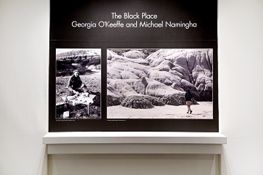
The Black Place: Georgia O'Keeffe and Michael Namingha
Touring Exhibition 2018 - 2018
Organized by
View full schedule with 1 venues
Georgia O'Keeffe Museum
Santa Fe/New Mexico
April 28, 2018 - October 28, 2018
O’Keeffe first saw the landscape she called “The Black Place” in 1935. Between 1936 and 1949, she returned to the remote site many times to create more than a dozen major works, primarily abstract compositions. In 2017, the artist Michael Namingha visited the same location to create work defined by a spare contemporary aesthetic. The Georgia O’Keeffe Museum is proud to present their work in conversation in an installation that includes paintings and drawings by O’Keeffe as well as new photographically based work by Michael Namingha created in 2017/18. Traveling 150 miles west of her Ghost Ranch home, O’Keeffe’s painting expeditions required an overnight stay, camping equipment, water and food, in addition to her drawing and painting supplies. In 2017, Namingha made a daytrip to The Black Place for the first time. The multidisciplinary artist carried only one tool, a drone camera. He returned to his studio with digital photographs and video recordings, a resource that he has developed into individual works of art during the past year. His work, like most of O’Keeffe’s, is not descriptive of the site, but refined and edited digitally to form a wondrous and disorienting experience for viewers. Working on a computer, Namingha divides, moves, and pulls the images using commands such as 'distort', 'skew', or 'perspective'. When he is satisfied with the shape of his photographic image, he adds geometric bands of color to the composition, to emphasize, highlight, and complicate the visual meaning. He begins with black but often transforms the color after completing the composition. The colors reference the activities of hydraulic fracturing, a technique for extracting oil and gas from deep beneath the surface of the earth. Brilliant yellow denotes the series of markers that trace the underground pipeline. The hot pink comes from maps created by NASA and the University of Michigan from a study of satellite data that recorded a large concentration of methane over the Four Corners region. The satellite images translate gases into false color maps. They selected pink and red to mark the “hottest” areas. Namingha chose that pink to represent these findings and to bring awareness to what is currently happening in this region. Namingha’s work formally invites the viewers to consider the relationship between the fragile beauty of the site and nearby and active extraction processes that threaten and change landscapes formed over time in the slow processes of natural accretion and erosion. O’Keeffe painted in the region through the 1940s, even after Uranium mining commenced in the area. Her radical abstractions of the strangely beautiful geology carry no signs of human presence or disruption. Created in different centuries but inspired by the same remote site, comparing Namingha’s artwork to O’Keeffe’s presents an opportunity to examine our evolving notions of art and the landscape of New Mexico.
Courtesy of Georgia O'Keeffe Museum. Photo: Tim Nighswander/IMAGING4ART
Image: Image Name.jpg