
|
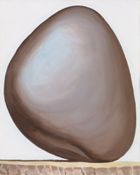
Oil on canvas, 20 3/16 x 16 1/4 inches
CR No. 1485
|
Gift of The Georgia O'Keeffe Foundation
2006.5.380
|
A large rock fills much of the canvas. It rests on a flat surface and casts a slim shadow underneath its left side. The rock is dark in color; however, a lighter area towards the left side seems to reflect a bit of light. The background is also light.
CR No. 1485
Title (1999 Catalogue Raisonné)
Black Rock with White Background
Source of title: Abiquiú Notebooks after 1977.
General Remarks
Not recorded Whitney Archive, Downtown Gallery Archive. Part of series, see cat. nos. 1517–22, 1578–80. (Source: Lynes, 1999)
Technique
Oil Painting
Materials
Oil on canvas
2010–2011
2011–2012
2018–2019
Crystal Bridges Museum of American Art
North Carolina Museum of Art
New Britain Museum of American Art
2022–2025
Estate of the artist, 1986
Georgia O’Keeffe Foundation, 1993
Gift to Georgia O’Keeffe Museum, 2006
(Source: Georgia O'Keeffe Museum, 2025)
© Georgia O'Keeffe Museum
Version History
Core fields last updated 10/15/2026
Last verified by current collection
Source System ID
1053
| Date | Field | Changed From | Changed To |
|---|---|---|---|
| mm/dd/yyyy | Artist | Changed from data | Changed to data |
| mm/dd/yyyy | Main title | Changed from data | Changed to data |
| mm/dd/yyyy | Year | Changed from data | Changed to data |
| mm/dd/yyyy | Media | Changed from data | Changed to data |
| mm/dd/yyyy | Credit line | Changed from data | Changed to data |
| mm/dd/yyyy | Provenance | Changed from data | Changed to data |
Conservation
Information is from the most recently submitted report, please contact the current owner to verify updated details.Support: The support is a medium-weight, relatively open, coarsely spun, basket-weave 2 x 2 cotton tacked to a commercial turnbuckle stretcher with metal corner inserts (stamped on stretcher). Canvas folds approximately ½" over to the back side of the stretcher and is tacked down, indicating preparation of the canvas by a studio assistant.
Ground or Support Preparation: Artist or artist's assistant appears to have applied a dilute protein size, such as rabbit-skin glue or gelatin, followed by a priming of alternating layers of lead carbonate (PbCO3) in oil and zinc oxide (ZnO) in oil. The priming appears to be applied in limited coats without sanding. X-ray fluorescence may reveal if barium sulfate is also present in the ground layer.
Design Layers: Graphite underdrawing is seldom visible at the margins of adjacent forms. The work is executed in single and double layers of stiff, paste-like paints, with multiple layers used at the brightest values. Brush texture is generally retained in the stiff paints of brighter values. Cream, vehicular paints, nearly smooth and leveled, occur only in isolated, dark values. There are frequent, linear, raised ridges of paint at the margins of forms. Scrubbing or zigzag brushwork has often been used in brighter values. The artist has executed gradual, stepped transitions in value or hue, often painting wet into dry in brief, slightly overlapping bands in a technique suggestive of pastel application. Brush strokes with grooves are evident in the fluid areas. There are raised brush edges where the black rock abuts the white background. Long fluid linear strokes create the base form on which the rock rests, and below that, short, dry, thin, and pasty paint application defines the side of the base form. The artist changes the background color from light green to white, presumably from 1963 to 1971, resulting in the thick appearance of the matte white background. This change also resulted in small flecks of green paint being transferred to other areas, likely through the use of the same brush. There is a small loose paint chip, appearing blue, white, and fibrous, at the bottom inside edge of the frame that is most likely from the tacking edge. Other, much smaller flakes are also seen along the bottom spacer.
Surface Coating: There are no records indicating a varnish application, though the surface slightly repels liquids.
Framing, Backing, and Hanging Hardware: The work is framed in a contemporary, micro-environmentally buffered, and gasketed, metal leaf "clam shell" profile frame that is a reproduction of Georgia O'Keeffe's original design, created by herself and framer/artist George Of. The glazing is Optium® tin salt-coated, UV-absorbing, static-free, non-reflective acrylic. The Optium glazing has a Volara closed-cell polyethylene gasket/pad. The frame is fitted with a laminated, Volara-gasketed backing strainer which has Security mirror-hanger and T-bolt hardware as well as D-rings.
Cracks are present along the stretcher bar lip along all edges of the painting and intermittently around the inner edge of the stretcher bar. There is a curvilinear, branched crack near the top edge of the canvas to the left of the rock form. Numerous paint, brush, hair, or fiber inclusions are scattered throughout the painting. At the lower portion of the white area in the rock is a very thinly painted area, approximately ¼" in size.
The upper left corner tacking edge was previously opened up, exposing cracks in the paint layer and frayed canvas fibers. This area was treated in 2011 using a Japanese paper hinge to stabilize the area. A small indentation, due to technique, may be seen in the brown paint near the top right side. There are small losses at the lower left and lower right corners. A few pinpoint losses may be found along the stretcher bar lip cracks. Abrasions from previous framing are visible at the top edge and on the upper left and right edges. There is a light abrasion at the center top edge and at the lower edge at approximately 3 ½" in from the left and ¾" up from the bottom. There is a very slight cusp at the lower right corner. Soiling is visible in the yellow area below the rock, right of center.
DOWNLOAD IMAGE
Terms of use
The Georgia O'Keeffe Museum is dedicated to fostering access to its collections to inspire education, research, and creative engagement. Through Access O'Keeffe, the Museum’s digital catalogue raisonné project, we provide free tools for engaging with Georgia O'Keeffe’s full body of work. As part of this initiative, we encourage the download of low-resolution images for educational and fair use purposes.
Certain works by Georgia O'Keeffe are under the copyright of the Georgia O'Keeffe Museum, while others are managed by different rights holders. For commercial uses, users must seek authorization directly from the respective copyright holder.
By downloading and using these images, users agree to the following terms and conditions of use including the Museum’s reproduction guidelines. Users will play a vital role in preserving the integrity of the artist’s work while supporting broader public access.
Permitted Uses
Fair Use:
Images may be used under fair use principles for purposes such as:
- Educational: Use in teaching materials, presentations, and coursework
- Research and scholarship: Academic research articles, theses, dissertations and noncommercial publications
- Creative projects: Reference or inspiration for personal artwork, such as sketches, paintings, or digital art, if the works are not sold or used commercially.
Conditions of Use
By downloading images of artwork from Access O'Keeffe, users agree to adhere to the Museum’s reproduction guidelines for artwork by Georgia O'Keeffe. Images must not be altered, manipulated, or modified in any way that compromises their integrity or misrepresents the original work. Specifically, artworks may not be cropped, distorted, or subjected to the following alterations:
- Cropping
- Rotation, inversion, or changes to the original proportions
- Color adjustments
- Superimposition of text, graphics, or other elements
- Animation, cartooning, or other forms of reinterpretation
- Removal or modification of blemishes, inscriptions, or other original features
- Printing artwork on 3D materials, including fabrics
Unauthorized Uses
Unauthorized uses of Georgia O'Keeffe’s works include any applications that fall outside the scope of fair use, such as those intended for commercial profit generating purposes.
Examples include, but are not limited to:
- Publications and merchandise that are sold or generate income.
- Reproductions in marketing materials, advertisements, or promotional campaigns.
- Use in exhibitions or displays that charge admission fees.
For any such uses, prior written authorization must be obtained from the appropriate copyright holder noted in Access O'Keeffe.
For any commercial use, prior written permission is required from the copyright holder. Please contact the Digital Experience and Rights Manager at [email protected]
ADD TO LIST
COPY CITATION
Georgia O'Keeffe. Black Rock with White Background, 1963–1971. Access O’Keeffe, Georgia O’Keeffe Museum, https://access-ok.okeeffemuseum.org/object/1053.